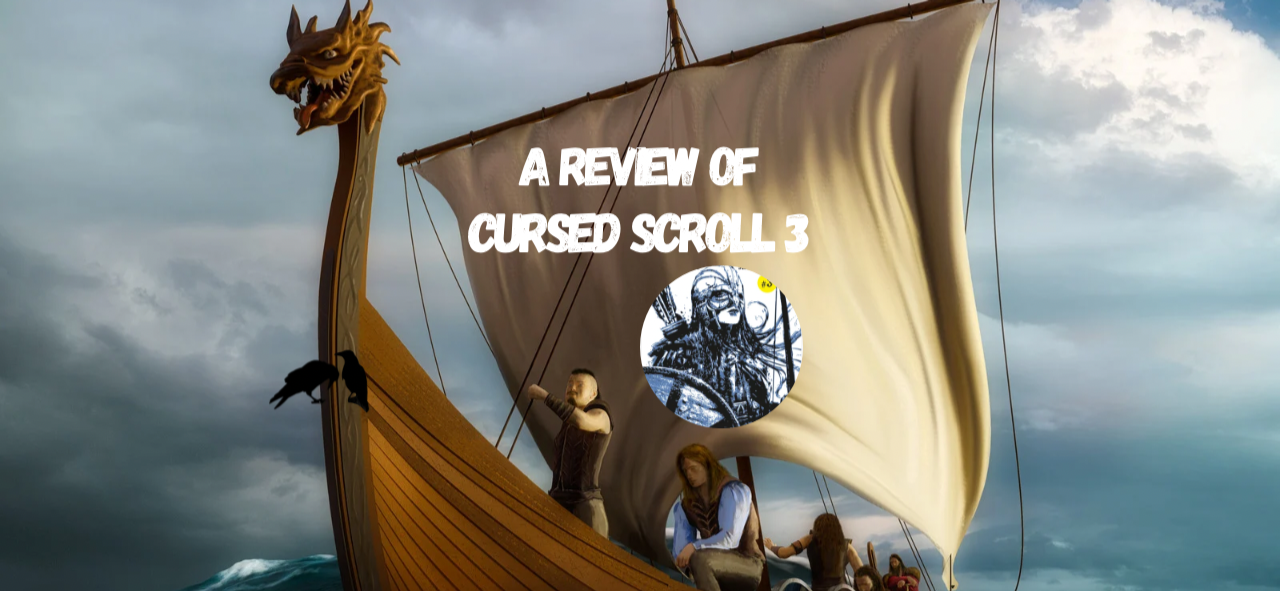
A Review of Cursed Scroll #3: Midnight Sun
Cursed Scroll #3: Midnight Sun
The first two Cursed Scrolls made good use of their limited space. Diablerie! gave us the Gloaming, with its witches, cursed knights, and monsters. Red Sands took us into the Djurum and made the desert matter at the table. Midnight Sun heads north to the Isles of Andrik, where raiders sail under a sun that refuses to set.
If you are new to the game, my Shadowdark review covers the rules these supplements build upon. Here I want to know whether Midnight Sun gives me enough to run its northern setting and whether I would use what it adds.
The Sea Wolf and Seer are the clearest reasons to bring this issue to the table. Each has a strong identity. The Sea Wolf chooses an allegiance to Odin, Freya, or Loki each day, gaining a different benefit from that choice. Its shield wall gives the player a useful defensive decision in combat, and its talents leave room for the berserker or shield maiden promised in the class description. I could take a Sea Wolf into another campaign easily, though I would want that campaign to give them a ship sooner or later.
The Seer is more deeply rooted in Andrik. The class reads fate, gathers luck, and casts spells associated with the Old Gods. Roll a natural 1 on a casting check, and the Seer may have to perform a penance before casting that spell again. Some penances carry enough weight to change the party’s plans. This is where the class gets interesting: a bad roll can become a problem everyone has to reckon with, rather than a brief pause before the next spell.
The backgrounds, names, titles, gods, and spells give both classes a place among the people of the isles. A player can make a character who belongs here without first reading twenty pages of history.
Oaths and Longboats
The oath rules might be my favorite addition. A character swears an oath before the Old Gods, states it aloud before a witness, and must fulfill it before gaining another level. Success brings a lasting reward; breaking it brings a lasting penalty. It is a small rule with plenty of room for trouble.
The boat rules give a group what it needs to choose a vessel, carry supplies, travel, and worry about sinking. The sea encounter table can bring weather, rival raiders, and monsters. Yes, there is a megalodon lurking beneath those waters. Wortwick Monastery provides a coastal raid the GM can put to work quickly, while the replacement character table solves a more ordinary problem: how to get someone back into a gauntlet after a death. I appreciate a supplement that remembers the game has to keep moving.
The Isles of Andrik
Andrik has steep coasts, cold seas, rival settlements, drakes in the mountains, and plenty of reasons to sail toward an island you probably ought to avoid. The hex map gives the GM destinations and rumors without settling every mystery in advance. The details become useful when players choose a course, make a promise, or discover that somebody else has a claim on what they came to take.
That is how Midnight Sun makes its setting work. The Sea Wolf chooses a god during a rest. The Seer’s penance creates an obligation. An oath can turn a straightforward raid into a difficult decision. The book gives the GM situations to run, and the players learn what Andrik is like by dealing with them.
Hoard of the Sea Wolf King
The main adventure, Hoard of the Sea Wolf King, sends the crawlers into sea caves and tombs after a buried king’s wealth. Its 29 keyed areas give the issue a substantial destination, and I won’t spoil what the party finds inside. I would use the surrounding rumors and sea encounters before they reach it. I think a voyage becomes more memorable when the party has an oath to keep, or a reason to fear what is moving below the boat.
Of the first three Scrolls, Midnight Sun asks for the biggest commitment to its setting. You can lift the oaths, sea encounters, or replacement character table for another game. The Sea Wolf, Seer, voyages, and adventure make more sense together, though, with the Isles of Andrik on the map and a longboat under the party’s feet.
Diablerie! gave me pieces I could scatter across a dark fantasy campaign. Red Sands makes me want to take my players into the desert. Midnight Sun makes me want to point to an island on the horizon and ask who is willing to sail there.
Post a comment