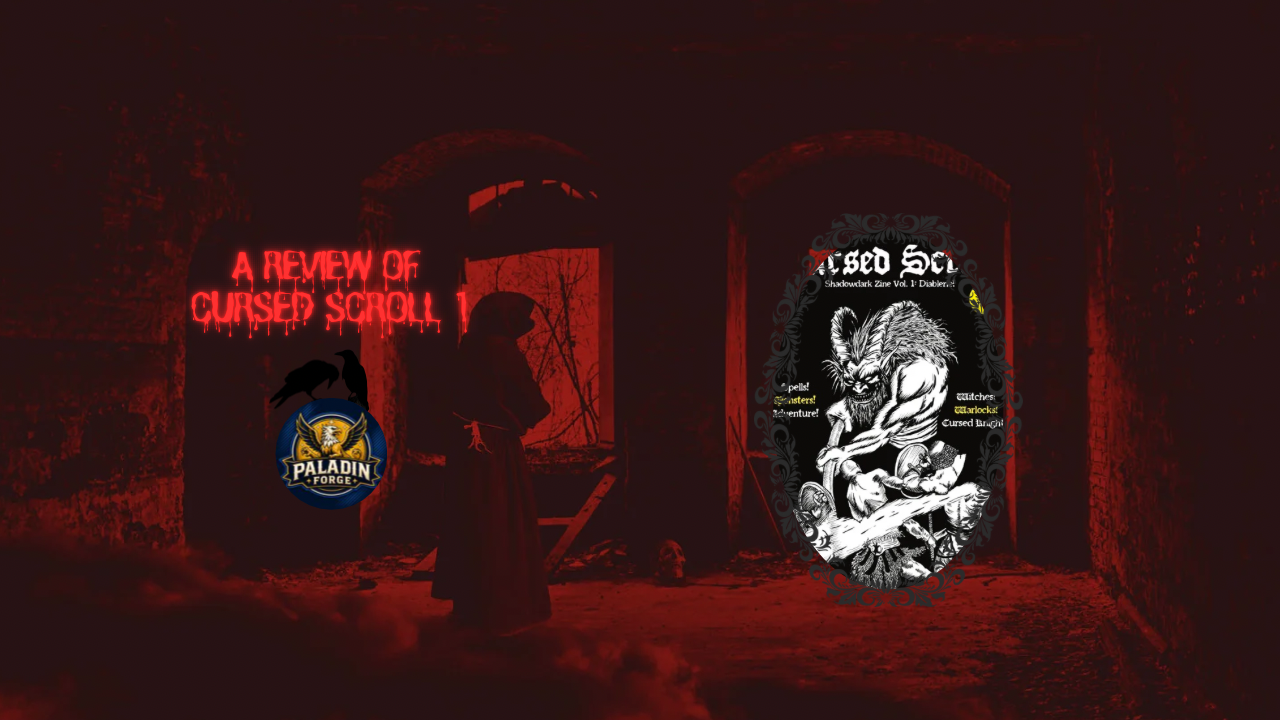
Shadowdark Review: Cursed Scroll 1
Shadowdark Review Cursed Scroll #1: Diablerie!
I bought Cursed Scroll #1: Diablerie! around the time Kelsey Dionne released the first three issues. I was already interested in Shadowdark, and anything that added more material to the game had my attention. Coming back to it now, though, I had forgotten just how much is packed into these 68 pages.
Calling Diablerie! a zine almost undersells it. This is essentially a themed expansion for Shadowdark, built around demons, curses, witchcraft, and the occult. There are three new classes, class titles, patrons and patron boons, backgrounds, spells, magical mishaps, monsters, a wilderness setting, and a hex crawl. Dionne wastes little time establishing what she means by diablerie. The word itself is an old term for sorcery, black magic, or dealings with the devil, and that’s essentially the territory she’s declaring here. The zine's introduction, describes the issue as filled with material about demons, deviltry, curses, the occult, and witchcraft. It’s a good description of what follows, because the theme isn’t merely window dressing. Nearly everything in the book, from the new classes and magic to The Gloaming and its monsters, is built around it.
Even if you never use the setting or adventure, there’s a pretty good argument that the three character classes alone make Cursed Scroll #1 worth owning.
Three Classes That Matter
Shadowdark’s core class selection is intentionally small. That’s one of the things I like about the game. It doesn’t bury players beneath dozens of classes, subclasses, and character-building decisions before anybody has actually sat down to play. I covered the core game in my earlier Shadowdark: A Review, including why that simplicity is one of its strengths. That also means a supplement adding three genuinely different classes can substantially expand the game.
And these aren’t obscure classes invented to fill pages. Two are heavy hitters in fantasy gaming: the Warlock and Witch. The third, the Knight of St. Ydris, occupies the equally recognizable territory of the cursed warrior, a heavily armed fighter willing to use forbidden powers against the darkness he is fighting.
The Knight of St. Ydris might be my favorite concept of the three. The order embraces darkness to fight it, and the mechanics back that up. Knights get broad access to weapons and armor, a Demonic Possession ability that increases their damage, and eventually access to Witch spells.
It doesn’t take three pages of mechanics to explain what this character is supposed to be. You read the class and immediately understand the fantasy.
The Warlock takes a completely different approach. The class revolves around serving a supernatural patron who provides its gifts. Warlocks receive a Patron Boon at first level and can gain additional boons as they advance, but the relationship isn’t entirely under the player’s control. The patron can grant or withhold those gifts based on what happens in play. That turns the patron into something the Game Master can actually use rather than a name written on the back of a character sheet.
The Witch is probably the easiest of the three to drop into almost any Shadowdark campaign. It’s a Charisma-based spellcaster, but the familiar gives the class its personality. A raven, rat, frog, or other small animal accompanies the Witch, can speak Common, and can act as the source of her spells when determining range. If the familiar dies, the Witch can restore it by permanently sacrificing hit points.
Taken together, these classes don’t pad Shadowdark’s class list. They expand it. If Cursed Scroll #1 contained nothing but these classes and the material supporting them, I’d still consider it a worthwhile addition to the game. Fortunately, there’s a lot more here.
Magic With Consequences
The Witch and Knight of St. Ydris connect to a collection of new spells, and spellcasting brings along one of my favorite parts of the book: the Diabolical Mishap tables.
Shadowdark already makes magic uncertain because spells require spellcasting checks rather than traditional spell slots. Diablerie! pushes that uncertainty further. Roll a natural 1 while casting Witch magic and things can go badly wrong, with increasingly nasty consequences as the spell tiers rise.
That’s the kind of magic that fits Shadowdark. Magic is powerful and tempting, but it isn’t always predictable. Something strange is being tampered with, and sometimes it pushes back.
Why do you think wizards build their towers out in the middle of nowhere?
The patrons reinforce the same idea. Almazzat, Kytheros, Mugdulblub, Shune the Vile, Titania, and the Willowman aren’t simply interchangeable sources of bonuses. Each brings its own identity and agenda to the game.
The Gloaming
The Gloaming is a miniature hexcrawl centered on an ancient forest of black trees, standing stones, bogs, isolated settlements, and cursed marrow trees from which demons emerge. Humans survive behind palisades while the Knights of St. Ydris fight what appears to be a losing war against the creatures inhabiting the woods.
What works particularly well is how little space Dionne needs to make the place feel alive. The hex descriptions aren’t lore dumps. They’re situations. A village medicine woman is secretly a hag poisoning the people she’s supposedly healing. An outlaw Knight of St. Ydris leads bandits who unknowingly serve a marrow fiend that eventually intends to eat them. An eccentric witch collects leeches in jars. Titania and her actors perform inside a faerie ring during the full moon. A swamp dragon accepts human sacrifices, while an ancient sorcerer remains trapped in a horrible well.
Pick practically any hex and something is already happening. The Knights of St. Ydris also become more interesting here. Their priory reveals that St. Ydris himself remains alive at 160 years old, willingly bound inside a magical circle because doing so traps the demon lord possessing him. Initiates gain their abilities by drinking his cursed blood and surviving, while swearing to use those powers against demons without surrendering themselves to evil. That’s good worldbuilding because it doesn’t merely explain the class. It gives the class a place in the world.
Monsters That Belong Here
The monster section isn’t huge, but the creatures feel like they belong specifically to this setting rather than being a collection of slightly modified fantasy standards. There are Bittermolds, Bogthorns, Dralechs, Hexlings, Ichor Oozes, Marrow Fiends, mutant catfish, Tar Bats, Skrell, Mugdulblub, and the Willowman. Their mechanics are generally as economical as Shadowdark monsters should be. Dralechs can destroy nonmagical equipment instead of dealing damage. Hexlings drain Constitution and can transform their victims. Tar Bats seek open flames and ignite when they reach them.
That last one is particularly nasty in Shadowdark because light isn’t scenery. It’s a resource. A monster specifically attracted to your torch creates a problem beyond losing a few hit points.
The Hideous Halls of Mugdulblub
The back half of the book contains The Hideous Halls of Mugdulblub, a first-level adventure beneath the ruins of Bittermold Keep.
The premise is wonderfully strange. A primordial ooze called Mugdulblub corrupted the Bittermold family and now sits beneath their ruined keep while competing groups fight for its favor. The descendants of the Bittermolds are at war with fanatical Howlers (halflings), while mutated catfish have developed legs, limited intelligence, and an understandable resentment toward anyone sacrificing catfish to an eldritch slime god. Mugdulblub encourages the conflict because the survivors will presumably be better suited to protect and feed it.
The factions make the dungeon more interesting than clearing 33 numbered rooms. The Howlers and Bittermolds react to fighting, reinforce nearby allies, retreat when necessary, set ambushes, and can potentially negotiate with the characters. The mutant catfish add another faction with their own interests, including an elderly “Wise One” willing to reward the characters for killing the Bittermold leader.
The individual rooms are filled with things players can actually interact with. There’s a pipe organ that rewards an appropriately unholy tune but responds to pleasant music by filling the room with poison gas. A meteorite chest becomes increasingly likely to suck someone into a starry void as treasure is removed. A fountain heals characters while also mutating them. A time flux can suddenly age or de-age anyone entering it. There’s even a wise, solid-gold mutant catfish who charges five gold pieces to answer questions and is only right 70 percent of the time.
That’s the kind of dungeon I enjoy. Players aren’t simply deciding which attack to use. They’re exploring, experimenting, bargaining, taking risks, and occasionally discovering that touching the weird thing was a bad idea.
Built to Be Used
The zine has a strong black-and-white identity, with heavy blackletter headings, old-school fantasy illustration, straightforward tables, and plenty of white space. More important is the usability. In the adventure, keyworded room descriptions are specifically identified as information safe to share with players, while the bullet points beneath them contain the GM information. The two-page dungeon map also marks faction locations, secret doors, barricades, environmental hazards, water depth, and other information the GM needs. It looks and feels like something intended to be run at the table.
Final Thoughts
In 68 pages, Diablerie! adds three meaningful classes, supporting character options, magic, mishaps, patrons, monsters, a miniature campaign region, a hex crawl, a 33-area first-level dungeon, maps, and treasure without feeling bloated.
More importantly, the pieces fit together. The Knight of St. Ydris isn’t merely floating around in a rulebook. There’s an order of those knights living in The Gloaming. The patrons aren’t merely character-generation options. Their influence appears throughout the setting. The monsters inhabit the wilderness and dungeon, while Mugdulblub’s influence is changing the landscape and the factions fighting beneath Bittermold Keep.
That’s what makes Cursed Scroll #1: Diablerie! work. It’s compact without feeling small, weird without becoming incoherent, and full of material that can actually make it onto the table. For the three classes alone, I think it’s worth having.
Everything after that makes the recommendation considerably easier.
Post a comment