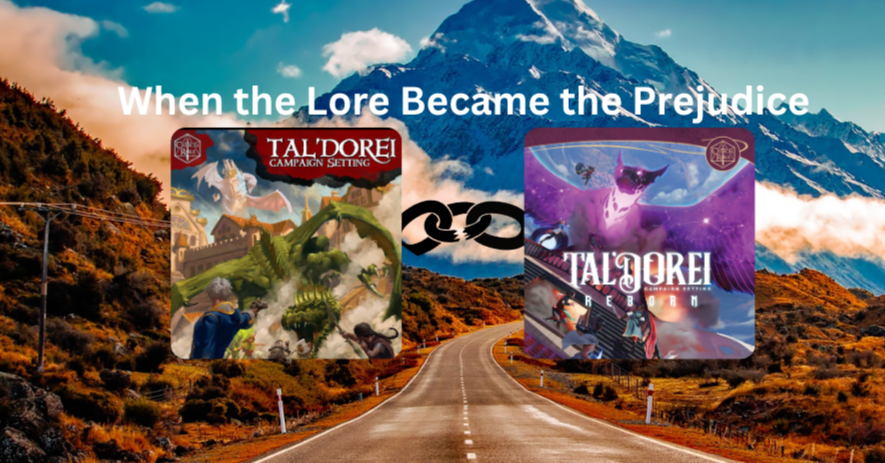
When the Lore Became the Prejudice
I own both Tal’Dorei campaign setting books. I already knew what Tal’Dorei Campaign Setting Reborn said about orcs, but reading through the original left me absolutely gobsmacked. In the 2017 Green Ronin book, orcs are overwhelmingly violent creatures whose bloodlust has a supernatural origin. During the Calamity, the Ruiner’s spilled blood transformed mortals and left their descendants struggling beneath that corruption. Compassionate exceptions exist, but they are rare. By the time Darrington Press released Reborn in January 2022, that explanation had become a harmful myth. I like Critical Role and the people who make it, and I appreciate what they built. That is part of why the difference between these two books is worth discussing on the terms the books themselves set.
The newer book describes orcs working throughout society and people condemning discrimination against their orc neighbors. In less than five years, something the authors had established as a fact about their world became a prejudice held by people within it. Somewhere between these two editions, CERN must have put us in another timeline.
What the Original Book Actually Said
The original book is quite clear about what it means. Its account on page 126 moves beyond describing what frightened villagers believe and explains the supernatural condition behind orc violence. It also acknowledges the capacity for tenderness and compassion that survives in some individuals. Those exceptions matter because they show that the authors had already considered the possibility of a good orc and included it in the setting. They simply made that goodness exceptional. Readers did not have to invent an explanation for the danger posed by orc raiders, nor did they have to assume that the creatures represented anyone outside the game. The setting supplied its own explanation, grounded in its gods, its history, and its supernatural conflicts. When that approach was challenged publicly, Matthew Mercer defended precisely those choices.
Mercer Defends His Setting
In September 2017, Sanjay Merchant addressed an open letter to Mercer and tagged Critical Role, Green Ronin, Talks Machina, and Geek & Sundry. His objection connected the treatment of fictional orcs to attitudes toward real people, arguing from the premise that RPGs function as wish fulfillment and practice for social behavior. Mercer answered that his orcs originated in a dark god’s corruption, supplied a recognizable danger for adventures, and included exceptions. He rejected the minority analogy. Merchant subsequently invoked his immigrant father’s safety. That exchange does not prove that Merchant caused the eventual rewrite, but the tagging deserves scrutiny: he brought Mercer’s professional associates into a public moral accusation. I read that as an attempt to apply professional pressure. Mercer held his ground.
The tagging was a pressure move, and describing it that way is accurate rather than an overreach. Merchant did not send a private note or a reply limited to Mercer. He posted an open letter that tagged Critical Role, Green Ronin, Talks Machina, and Geek & Sundry while accusing the published setting of toxic stereotypes and linking it to real-world harm. In the environment of 2017 (and the years around it), that combination is a recognizable tactic: it expands the audience from the author to his professional associates and raises the potential cost of holding the position. The follow-up about his immigrant father’s safety added an emotional stake that further framed disagreement as indifference to real danger. Those are observable choices, not hidden motives that require special insight to notice.
Your DM Is Not a Genie
I want to say emphatically that RPGs are not, by definition, a form of wish fulfillment. Your DM is not a genie. It is a game with rules and parameters that everyone agrees to play within. You make decisions, face challenges, and deal with consequences. You can fail. Your character can die. The world does not owe you the outcome you want. Enjoying a fictional adventure does not establish a desire to act out its violence in real life, any more than an actor portraying a murderer establishes that he wants to kill someone. Merchant’s argument requires that connection to work. Calling the game wish fulfillment is a thin, weak substitute for demonstrating it. In addition, invoking his father’s safety is emotional manipulation.
Concern about real violence can be entirely sincere without establishing a connection between that violence and this particular campaign setting. Mercer had explained the fictional cause of his creatures’ behavior, and the response placed him in the position of answering for a possible attack on someone’s father. In what wacky timeline is that acceptable? The missing connection remains missing, to this day.
A critic is entitled to argue that certain fictional conventions have harmful implications, but the gravity of the accusation increases the accountability to demonstrate it. Which Merchant cannot do without attaching emotional pleas. Otherwise, an author can explain his work accurately, answer the criticism directly, and still find himself defending his moral character against consequences that have only been asserted. Mercer was entitled to reject that framing, and players were entitled to enjoy his setting without accepting that their game amounted to a confession about their attitudes toward humanity.
From Supernatural Corruption to Harmful Myth
There is, however, an important development between that exchange and the publication of Reborn. In an interview published by SYFY WIRE in April 2020, Mercer explained that his thinking had changed. He connected his earlier approach to growing up with Tolkien and other fantasy, and described his preference for morality arising from individual experiences and choices rather than ancestry, a preference compatible with several different ways of revising the setting. That is a public explanation of a change in creative philosophy. It would be inaccurate to claim that the reversal appeared without warning, just as it would be inaccurate to claim that Merchant’s letter alone forced it. The record supports a narrower and more interesting account: Mercer defended the original approach in 2017, publicly articulated a different approach by 2020, and participated in a revised setting book that embedded the newer philosophy in its lore. Readers can acknowledge his explanation while questioning both its premise and its execution.
The execution is where the contradiction becomes especially difficult to dismiss. On page 39, Reborn declares: “The truth is that the Curse of Ruin is a myth.” The Ruiner’s blood gave orcs physical power but imparted none of his evil. The revision does more than change how orcs behave; it declares that the supernatural explanation supplied by the original book was never true. The book then discusses the damage caused by belief in that supposed inheritance. This reaches backward into the setting’s foundations. A curse weakening over generations would have been a development within the existing account. An adventure that broke it would have given characters a role in changing their world. Discovering communities that had escaped its influence could have complicated what people knew. Instead, the revision declares that the inherited evil was never there. The original explanation has been replaced, and belief in something resembling that explanation is now part of the setting’s discussion of prejudice.
We Read What They Wrote
None of this means Reborn lacks enemies or prevents adventurers from fighting evil orcs. The Ravagers remain a murderous death cult, and their actions give a party ample reason to oppose them. Nor must an author preserve every detail of an earlier edition forever. The issue is how the revision handles information its predecessor presented as authoritative. Readers who accepted the original supernatural explanation were following the book as written.
I find Mercer’s original defense persuasive. A fantasy world can contain creatures corrupted by an evil power without making a statement about real populations. A different setting can present orcs as neighbors, scholars, and adventurers. Either approach can support a game. Moving between them, however, raises a practical question beyond which portrayal the authors now prefer: what can players and DMs rely on when they build campaigns around a published setting?
What a Published Setting Owes Its Readers
A published campaign setting makes a practical promise: this information gives you a world you can use. DMs build adventures around its history, players create characters shaped by its conflicts, and both rely on a shared understanding of what is true. Authors remain free to revise that world. Their published explanations have, however, already become the foundations of other people’s campaigns. A table that built adventures around resisting that corruption can continue, but it must now treat the publisher’s later account as optional.
Uncertainty is useful when a setting establishes it honestly. Competing legends, unreliable histories, and disputed religious claims give players something to investigate. An authoritative explanation serves a different purpose: it gives the DM information on which to build. Recasting that explanation as an in-world prejudice changes its function after readers have relied on it. If this becomes a recurring method of revision, readers have reason to question which parts of the setting will remain dependable and which might later be assigned a moral stigma.
Mercer’s preference for individual morality allowed several approaches. The curse could have weakened or become curable, creating opportunities for characters to change their world. The revised edition could also have acknowledged directly that it was replacing the original premise. Reborn chose instead to declare the inherited evil a myth and explore the harm caused by believing in it. That choice places the burden of reconciling the accounts on the reader. A published setting can sustain substantial change, but its usefulness depends on whether readers can tell if something happened inside its history or its authors decided to rewrite that history. Readers deserve to know which occurred, especially when yesterday’s explanation becomes today’s prejudice.
Sources
- Matthew Mercer and James Haeck, Critical Role: Tal’Dorei Campaign Setting, Green Ronin Publishing, 2017, especially p. 126.
- Tal’Dorei Campaign Setting Reborn, Darrington Press, especially pp. 39, 162–163, and 249.
- The September 2017 Merchant–Mercer exchange, preserved by Sage Advice. The compilation page’s October 2022 date is separate from the date of the exchange.
- James Grebey’s interview with Matthew Mercer, SYFY WIRE, April 15, 2020.
- Darrington Press’s announcement of the January 18, 2022 release.
Post a comment