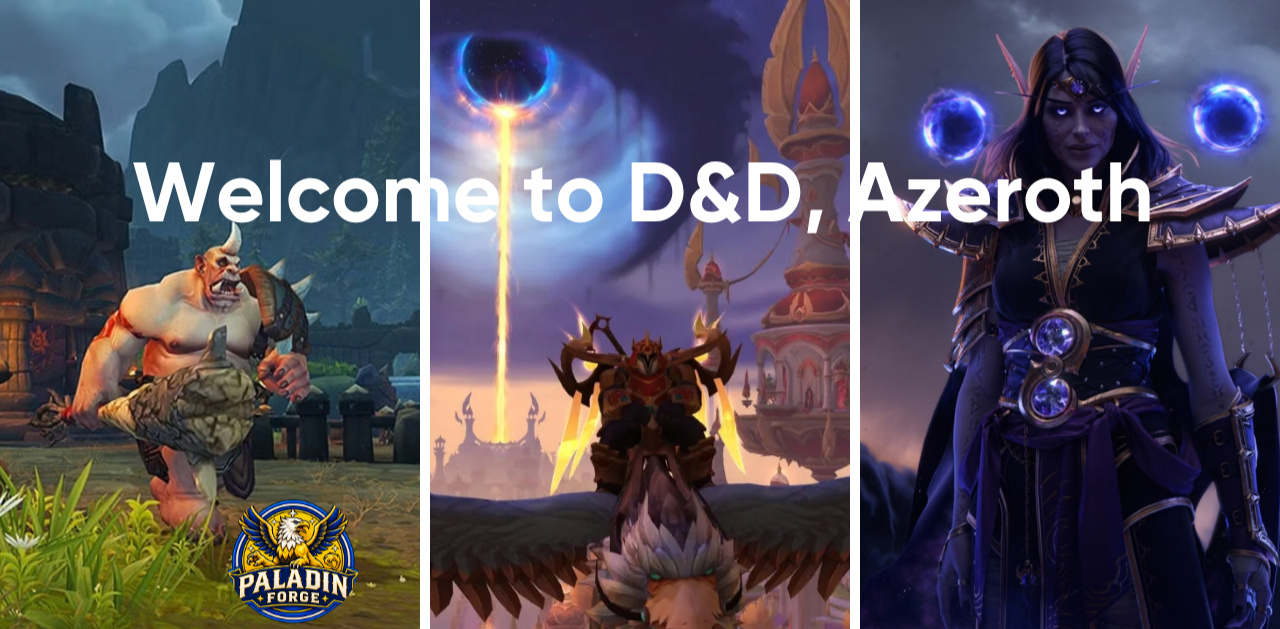
Welcome to D&D, Azeroth
You are not prepared.
Welcome to D&D, Azeroth
I have never played World of Warcraft. Not “I played it for a couple of months and bounced off,” or “I had an account back in the day.” I mean I have never once, in the history of my life, played World of Warcraft.
There is a fairly simple reason for that. World of Warcraft arrived during a strange stretch of my life when video games had largely disappeared from it. After I left the University of Oklahoma and before I eventually started my construction business, I wasn’t spending much time with Xboxes, computer games, or gaming in general. I spent about a year and a half down around New Orleans after Hurricane Katrina, helping rebuild and doing roofing work. By the time I settled into the next stage of my life, one of the biggest fantasy games in the world had passed me by.
Of course, you don’t spend decades around Dungeons & Dragons and fantasy gaming without absorbing some Warcraft through cultural osmosis. I know there are orcs, humans, elves, and dwarves. I know about the Horde and the Alliance. I’ve seen the movie, and I recognize quite a bit of the imagery. That’s about where my knowledge ends, though. I couldn’t explain the history of Azeroth, name its important places, or tell you who most of its major characters are.
That makes me an interesting, if probably unintended, audience for the free D&D: World of Warcraft Dungeon Masters Play-Along Pack. D&D Beyond released the pack alongside the live-play Dungeon Masters, taking material prepared for the actual-play series and adapting it so people can run the encounters at their own tables. I claimed it through my Paladin Forge D&D Beyond account and went in almost completely cold.
Right near the beginning, the preview points toward the D&D: World of Warcraft Ultimate Bundle. I clicked over because everything included sounded pretty cool, right up until I saw the $124.99 price tag. There is quite a bit in the bundle beyond the book, but some of the advertised Warcraft bonuses also require a Battle.net account, a WoW license, and an active World of Warcraft subscription. That moved me rather quickly from this sounds pretty cool to okay, never mind.”
Which Way Does the Bridge Run?
The Play-Along Pack contains two connected encounters for 5th-level characters set in Dire Maul, along with maps and monster stat blocks. The characters can be associated with either the Alliance or the Horde, and either way they’re sent looking for Gladiola, a tauren shaman who entered Dire Maul and hasn’t returned. The encounters originated from DM Jasmine Bhullar's preparation for the actual play and were then adapted for use at an ordinary D&D table.
It didn’t take long before I ran into a problem. The adventure told me I was going to Dire Maul in Feralas, and I had no idea what either of those things were. I wasn’t even initially sure whether Dire Maul was a place or a person. I started looking things up and discovered that it is the ruined night-elven city of Eldre’Thalas, located in Feralas on Kalimdor. That helped, but it also wasn’t information the preview seemed particularly concerned with teaching me.
At first, I wondered whether that was a weakness. The more I read, however, and particularly after looking around at reactions from World of Warcraft players, the more I thought I was approaching the preview from the wrong direction. This isn’t primarily an introduction to Azeroth for D&D players. It looks much more like an introduction to D&D for people who already know Azeroth.
That distinction changes the way I look at the entire thing. A longtime Warcraft player doesn’t need Dire Maul explained. Feralas isn’t a meaningless fantasy word. The Alliance and Horde aren’t two new factions that need pages of history before the adventure can begin. Those players already know the setting. What they may not know is how that setting works when you put character sheets on the table, roll a d20, make ability checks, run encounters, and translate familiar Warcraft creatures into D&D monsters.
The Play-Along Pack gives those players familiar ground and then puts D&D underneath their feet. It’s a bridge from Azeroth into D&D, not from D&D into Azeroth.
These Are Not Mr. Tumnus
The Shadowstalker Satyrs gave me a particularly good example of the difference between my experience and that of someone who already knows Warcraft. My knowledge of satyrs runs through Greek mythology, traditional fantasy, and, inevitably, James McAvoy playing Mr. Tumnus in The Chronicles of Narnia: The Lion, the Witch and the Wardrobe. When I encountered Warcraft’s satyrs, I discovered fairly quickly that Mr. Tumnus would be a very poor survival guide.
Warcraft’s satyrs descend from night elves transformed through demonic corruption, and the Shadowstalker presented here is a fiend built around stealth, darkness, and fel magic. Its mechanics communicate much of that even without knowing the lore. It can Hide as a Bonus Action in dim light or darkness and attacks with Fel Blades that deal necrotic damage. You can look at the stat block and understand what this creature is supposed to do when you put it on the table.
The same thing happens with some of the other monsters. The Felhound can detect magic, becomes particularly dangerous to creatures using it, grabs victims with its tentacles, and can use Drink Magic to temporarily prevent a creature from taking the Magic action. The Infernal is a Challenge Rating 12 brute with Siege Monster, Magic Resistance, ranged fel fire, and a Death Burst that causes it to explode when it reaches zero hit points. Once Bloodied, it can also go Berserk and attack the nearest creature rather than politely continuing to distinguish friend from foe.
That’s good monster design. The mechanics are doing some of the setting work.
I don’t think we need to go through every stat block or every room in Dire Maul to get the point. This isn’t an adventure walkthrough, and the Play-Along Pack is free for anyone who wants to see exactly how the encounters work. What matters to me is that the Warcraft creatures aren’t simply names pasted onto generic D&D monsters. At least in this sample, their mechanics communicate something about what they are and how they’re supposed to behave.
Familiar Ground, Different Game
The reaction from Warcraft players reinforced my impression of who this preview is aimed at. Looking around D&D Beyond’s comments and elsewhere, I found people already talking about Horde campaigns, characters they wanted to play, and introducing non-WoW friends to Azeroth. These weren’t people asking Wizards to explain what Dire Maul was. They were excited about getting D&D mechanics for a world they already knew.
There is also something clever about using an actual-play series as part of that introduction. A Warcraft player curious about D&D can watch people play and then download material connected to what they just watched. The show demonstrates the game while the Play-Along Pack gives them something they can take to their own table. Whether that approach carries into the eventual full product remains to be seen, but as an entry point the logic is easy to understand.
The unexpected part is that it worked on me too. Instead of the unfamiliar names making me lose interest, I became curious about the things I didn’t know. Somewhere along the way, I started thinking less about whether I understood every Warcraft reference and more about what kind of character I might play.
I think I already know. My first child was born around the same time Kung Fu Panda came out, and I’ve always had a soft spot for Po. So when I discovered that Azeroth has the Pandaren, panda-like humanoids with their own martial traditions, that immediately caught my attention. If I end up sitting down to play D&D: World of Warcraft, there’s a pretty good chance my first character is going to be a Pandaren.
By the time I finished reading, I wanted to play D&D in Azeroth. Nostalgia has nothing to do with that. I don’t have an old character waiting for me or memories of running Dire Maul twenty years ago. The little bit of Azeroth presented here simply looks like somewhere I’d enjoy exploring.
This is only a preview, so I’m not going to pretend two encounters and a few stat blocks tell us everything about the finished D&D: World of Warcraft. I’ll be interested to see whether the full book provides more support for D&D players coming into Azeroth without the Warcraft background that this preview largely assumes.
For what the Play-Along Pack appears to be trying to accomplish, though, I like it. There are a lot of World of Warcraft players who have spent years adventuring in Azeroth without ever sitting around a table and rolling dice to do it. Giving them familiar places, creatures, and factions as their entry point into D&D makes sense.
I’m glad Dungeons & Dragons brought Azeroth into the fold. It also accomplished something I wasn’t expecting: after nearly twenty-two years of completely missing World of Warcraft, I now want to roll up a Pandaren and see what Azeroth looks like from the other side of a DM screen.
Post a comment