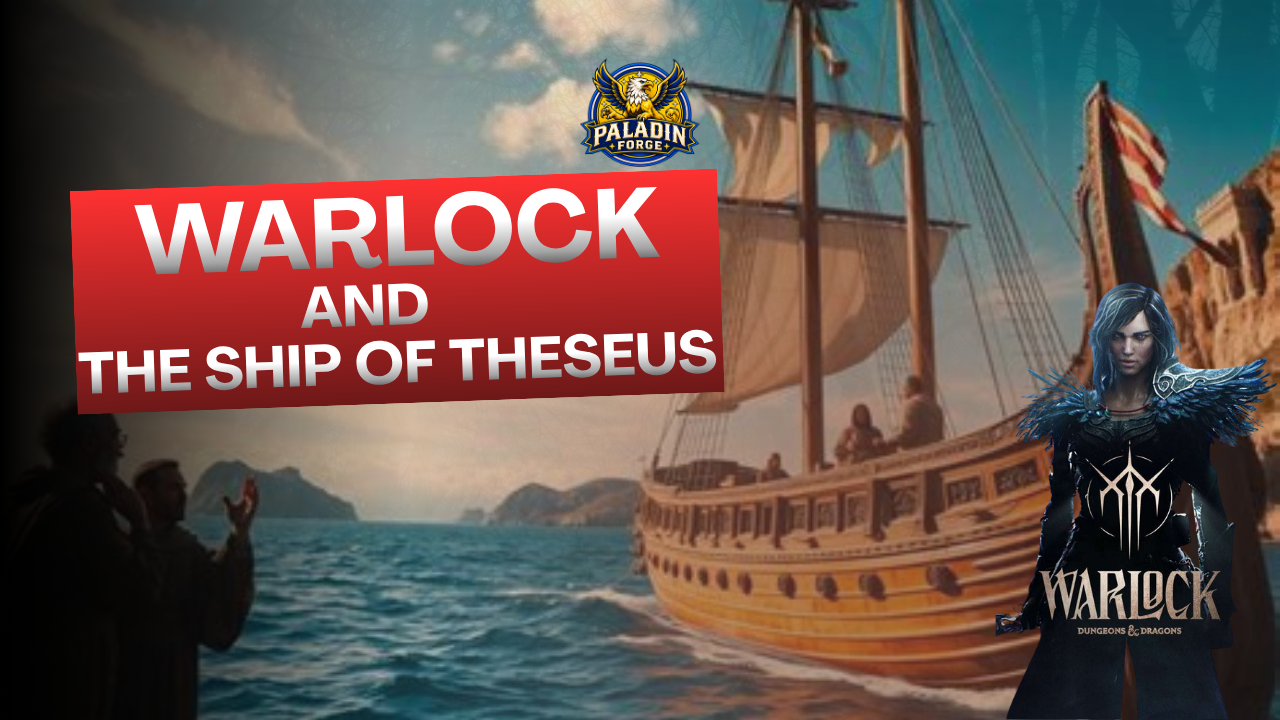
Warlock and The Ship of Theseus
The old that is strong does not wither.
Warlock: Dungeons & Dragons is an upcoming single-player, third-person action-adventure being developed by Invoke Studios and published by Wizards of the Coast. The player takes control of Kaatri, an experienced warrior who makes a pact with Tasha and enters Darkon, one of Ravenloft’s Domains of Dread. The premise sounds good. Darkon gives the developers access to Ravenloft without sending us through Castle Ravenloft for the hundredth time. The focus on forbidden magic has potential, and the game seems interested in letting players manipulate the environment rather than treating every spell as a different-colored bullet. There is plenty here that I want to like.
Invoke Studios head Dominic Guay says the game contains “deep cuts” from D&D’s history, but the developers do not want longtime fans to understand everything the moment they encounter it. They want experienced fans and newcomers alike to feel the mystery of entering a strange place and learning its rules. That sounds reasonable because fantasy suffers when every monster and location arrives with a complete wiki entry attached. A creature is more frightening before we know its Armor Class, hit points, immunities, and preferred breakfast. Guay has also explained that Warlock will use a minimal, customizable HUD rather than guiding players directly to every objective. A quest may mark a general area and provide a compass, but the player will still have to explore and discover the destination. If the game trusts players enough to let them become lost in Darkon, that is a welcome decision.
Guay also says the developers are trying to reproduce familiar D&D experiences, including discovering secret doors and dealing with traps, in real time and “without rolling down dice.” This is where the explanation starts to come apart. Not because every D&D video game needs to show a twenty-sided die bouncing across the screen. Many excellent adaptations have hidden the dice, automated the arithmetic, or altered rules that did not translate cleanly to a computer. The problem is that D&D video games have traditionally been built from the game outward, while Warlock appears to have been built from the brand inward. In Has D&D Become a Digital Business?, I argued that Wizards increasingly appears to regard D&D as a digital property supported by tabletop books rather than a tabletop game supported by digital products. Warlock gives us an opportunity to see what that distinction may eventually mean.
The Rules Were the Connection
The original Baldur’s Gate and Baldur’s Gate II were based upon Advanced Dungeons & Dragons Second Edition. They adapted THAC0, descending Armor Class, saving throws, spell memorization, weapon proficiencies, classes, and alignments from AD&D into the Infinity Engine. They changed things because they had to. Combat played out in real time with the ability to pause, while the computer performed most of the calculations and rolled the dice out of sight. Companions were written characters rather than friends sitting beside you at the table. A programmed game could never offer every possibility available through a living Dungeon Master, but nobody could seriously play Baldur’s Gate and miss the rules underneath it. The tabletop game formed the skeleton, and the video game was the adaptation.
The original Icewind Dale also used a modified version of AD&D Second Edition, while Icewind Dale II later moved to Dungeons & Dragons Third Edition. Once again, the developers were not merely raiding D&D for recognizable monsters and spell names. They were attempting to translate the contemporary tabletop system into a computer role-playing game. I played all four of those original Baldur’s Gate and Icewind Dale games as they were released, and today I own and still play their remastered editions. The exception is Icewind Dale II, which has never received an official Enhanced Edition because its original source code remains missing. Come on, Beamdog, find that code. These games remain part of my understanding of what a D&D video game is because the rules were always present, even when the computer kept them behind the curtain.
The original Baldur’s Gate: Dark Alliance complicates that history, but it does not overturn it. Released in 2001, it converted D&D into a real-time action game with direct attacks, regenerating magical energy, and cooperative hack-and-slash combat. Beneath those changes remained the recognizable skeleton of the then-current Third Edition rules. Characters still possessed Strength, Dexterity, Constitution, Intelligence, Wisdom, and Charisma. They had Armor Class, Base Attack Bonuses, hit points, experience levels, classes, feats, critical hits, and ability increases every four levels. Snowblind Studios changed how D&D was played on the screen, but it did not begin by declaring D&D’s rules irrelevant. I played it during my last year at the University of Oklahoma with my roommate Chappy, and great fun was had.
Baldur’s Gate: Dark Alliance II continued using that heavily modified Third Edition framework. Although D&D 3.5 had been released by the time the game arrived in 2004, there is little evidence that the developers rebuilt it specifically around that revision. Instead, they expanded the action-oriented system inherited from the first Dark Alliance. The sequel added new classes, spells, feats, weapon styles, combination attacks, and item creation while retaining familiar D&D statistics underneath. Neither game was a faithful tabletop simulation, nor were they trying to be. They were action games constructed upon a recognizable D&D foundation. When the sequel was released, I was living in South Beach and working at Prime 112, and I played the entire campaign solo and loved it.
The more revealing break came with Dungeons & Dragons: Dark Alliance in 2021. This was not the unreleased Dark Alliance III, but a spiritual successor starring Drizzt Do’Urden and the Companions of the Hall. Fifth Edition was the current tabletop game, and Dark Alliance borrowed some of its language, including the six ability scores, feats, conditions, classes, and short rests. Its actual machinery, however, was built around real-time brawler combat, predetermined heroes, stamina, parrying, combination attacks, gear scores, loot rarity, ability trees, and repeatable missions. The developers described it as the part of D&D that begins after the Dungeon Master tells everyone to roll initiative. That is clever marketing, but it also admits that most of the game occurring before and around initiative had been removed. The tabletop rules supplied names and concepts, but they no longer formed the actual structure of play.
This means Warlock is not the first D&D video game to separate the brand from the tabletop rules. The 2021 Dark Alliance had already moved considerably in that direction, and we should not pretend otherwise simply because it complicates the argument. What Warlock represents is the continuation of that branch of development, perhaps carried further than ever before. The original Dark Alliance replaced D&D’s pace and perspective while retaining much of its contemporary mechanical skeleton. The 2021 game retained recognizable statistics and terminology while replacing most of the system connecting them. Warlock now appears prepared to retain the world, characters, monsters, spells, and logo while constructing almost the entire vessel from a different kind of game.
Then came Baldur’s Gate 3, demonstrating that this movement was neither inevitable nor required by modern technology. Larian changed spells, actions, movement, encounters, character options, and other elements to make Fifth Edition work on a computer. Some tabletop players loved those changes, while others did not, but the foundation remained visible everywhere. Characters had classes, ability scores, proficiencies, saving throws, spell slots, and Armor Class. Combat was turn-based, an adventuring party moved through the world together, and players could create their own heroes or select established characters. Dialogue, exploration, and combat regularly turned upon the roll of a twenty-sided die.
Larian did not hide its relationship with tabletop D&D. It placed the die in the center of the screen and proved that modern audiences would embrace a video game built from D&D’s contemporary rules rather than merely decorated with its intellectual property. The choice facing Wizards is therefore not between adapting D&D beyond recognition or abandoning video games altogether. It is between two different understandings of what a D&D video game should be. One begins with the game and translates it into another medium. The other begins with the brand and builds an unrelated style of game around its most recognizable pieces.
That division exposes the problem with describing obscure lore as “deep cuts” while treating the rules as disposable. Knowing the name of a creature from a thirty-year-old Ravenloft supplement may demonstrate familiarity with D&D’s library, but recognition is not fidelity. Baldur’s Gate 3 changed the tabletop rules because translation required compromise. The original Dark Alliance altered them even more severely but still retained Third Edition as its statistical foundation. The 2021 Dark Alliance moved toward using D&D primarily as a setting, vocabulary, and collection of recognizable characters. Warlock appears to continue that movement until almost nothing remains except the intellectual property. That brings us to the Ship of Theseus.
How Many Planks Can You Replace?
The old philosophical problem asks us to imagine a ship preserved over many years. As its wooden planks rot, they are replaced one by one. The mast eventually goes, followed by the rudder, sails, deck, and every beam beneath it. After enough time passes, none of the original material remains. The ship still carries the same name, occupies the same place, and may even look identical from a distance. Yet everything from which it was constructed has been exchanged for something new. Is it still the same ship?
Dungeons & Dragons has been replacing planks for more than fifty years. Rules, publishers, artists, worlds, classes, monsters, and assumptions about play have all changed. The game played in Lake Geneva and the Twin Cities was not identical to AD&D. AD&D was not identical to Third Edition, and Third Edition was not identical to Fourth or Fifth. There was never one perfectly pure form of D&D followed at every table, and Gary Gygax and Dave Arneson did not even agree on every point. Players began modifying rules almost as soon as the rules existed. House rules are not an infection that later entered D&D because they are part of its blood.
Yet something survived all those changes. A referee described a world, and players created characters and decided what they would attempt within it. Rules gave those decisions structure while dice settled uncertain outcomes. Nobody at the table controlled the entire story because the story had not been written yet. Editions could change the particular rules, and individual tables could alter them further, without removing that underlying relationship. Those were the planks that continued holding the vessel together.
The Dungeon Master might create the dungeon, prepare the villains, and decide what was happening beyond the characters’ sight. Then the players arrived and began doing things no sensible person could have anticipated. They negotiated with the monster that was supposed to attack them, ignored the carefully prepared road, and marched into the swamp. They distrusted the innocent shopkeeper and handed the obviously sinister stranger the key to the city. Someone rolled a natural 20 or a natural 1, and the entire evening bent around it. The story emerged from that collision rather than being delivered to the players whole. It was discovered by everyone, including the Dungeon Master.
A video game can simulate an astonishing amount of freedom through branching conversations, alternate endings, reactive environments, and problems with several possible solutions. Warlock may do those things exceptionally well, and its reduced waypoint guidance could make exploration feel less mechanical than it does in many open-world games. But every possibility in a video game must ultimately fit inside a possibility created by its developers. Every secret door that opens was built to open, and every object that reacts to fire was programmed to react to fire. Every character who can be persuaded has dialogue prepared for being persuaded. The world may be enormous, but its boundaries were established before the player arrived.
At the table, a player can suggest something no designer, adventure writer, or Dungeon Master ever considered. The Dungeon Master thinks for a moment and says, “All right. Let’s see what happens.” There is no dialogue tree to consult and no invisible wall preventing the attempt. The referee makes a ruling, the dice fall, and the world responds. That may be the most important rule in Dungeons & Dragons. It cannot be reproduced simply by programming a larger selection of predetermined choices.
D&D the Game and D&D the Brand
This is where the distinction becomes important. As a game, D&D is something people do together. As intellectual property, D&D is a collection of recognizable names, worlds, characters, creatures, spells, and symbols. Those two identities have coexisted for decades, but they are not interchangeable. One describes an activity, while the other describes a box of marketable parts. Wizards increasingly appears interested in the parts that can travel without the activity.
A beholder is D&D. Tasha is D&D. Strahd is D&D. A mimic is D&D. The Forgotten Realms are D&D. Put enough of those pieces into another form of entertainment, attach the ampersand, and everyone recognizes the vessel sailing toward them. The question is whether that recognition is enough to make it the same vessel.
There is nothing inherently wrong with D&D existing beyond the tabletop. The brand escaped the table a long time ago through the Gold Box games, Eye of the Beholder, Baldur’s Gate, Planescape: Torment, Neverwinter Nights, decades of novels, the animated series, and Honor Among Thieves. Some were excellent, and plenty of people discovered the Forgotten Realms through a computer screen or a Drizzt novel before opening a campaign book. An adaptation does not need to reproduce tabletop play exactly to possess value. A novel does not need to ask the reader to roll initiative, and a movie does not require character sheets beside the screen. A video game does not need to simulate three players arguing about whether they remembered to buy rope. Those adaptations can strengthen the tabletop game when they lead people toward the experience that gave the worlds and characters their original life.
The question is not whether Warlock has permission to be different because, of course, it does. The question is whether it is adapting Dungeons & Dragons or simply using Dungeons & Dragons to identify the contents of an otherwise unrelated kind of game. If Warlock began as a third-person action-adventure and Tasha, Darkon, familiar monsters, spells, and the D&D logo were attached afterward, would anything fundamental about its design have to change? If the answer is no, the D&D name may be describing the decoration rather than the structure. That is where Warlock connects to the digital-business question. Wizards is developing a broader understanding of D&D in which the tabletop is only one platform among many. Within that understanding, portable pieces become more commercially valuable than the original experience because they can be placed into more products and sold to more people.
The tabletop experience is difficult to scale. Several people must coordinate their schedules, someone must prepare the game, and everyone must learn enough of the rules to participate. Players must listen to one another, compromise with one another, and accept that the evening may not follow anyone’s plan. A single-player digital product removes those difficulties because it is always ready and moves at the player’s pace. It does not require a Dungeon Master, four available friends, or a dining-room table that is not currently covered in laundry. From a business perspective, the attraction is obvious. From the perspective of preserving what makes Dungeons & Dragons different, it should make us uneasy.
The tabletop game is not an inefficient early version of the digital experience. The Dungeon Master is not a primitive computer waiting to be replaced by better software. Dice are not obsolete random-number generators left over from the years before electronics. The inconvenience of gathering actual human beings is not a design failure because those human beings are the point. Remove them and you may create something convenient, polished, and commercially successful, but you have also removed the relationship around which the game was built.
Is It Still Dungeons & Dragons?
Perhaps Warlock will become a doorway. Someone may finish Kaatri’s story, buy a rulebook, gather some friends, and discover a form of play no computer can reproduce. If that happens, Warlock will have served the larger inheritance well. I hope the game is excellent. This is not an argument for wanting it to fail. Hoping for an excellent game, however, does not require pretending that the question is meaningless. If Dungeons & Dragons can become a single-player action-adventure with a fixed protagonist, real-time combat, no Dungeon Master, no adventuring party, no player-created character, and no dice, what exactly must remain before the name no longer describes the game? How many planks are essential?
Dungeons & Dragons can survive new rules, worlds, editions, technology, and audiences because it has survived all of them before. Change is not the enemy, and preservation does not require sealing the game inside a glass case marked 1974. But change still requires judgment. Some planks can be replaced without changing the identity of the ship. Others may be holding the entire vessel together. The responsibility lies in knowing the difference before those pieces are discarded.
The danger is not that Warlock exists. The danger is that Wizards may eventually look at the version of D&D that requires no table, referee, group, dice, or shared imagination and decide that this is the ship it was trying to build all along. Replace the rotten boards, strengthen the hull, and raise better sails. Let the ship travel into waters its builders never imagined, but remember what made it a ship.
Maybe they already have.
0 Comments Add a Comment?