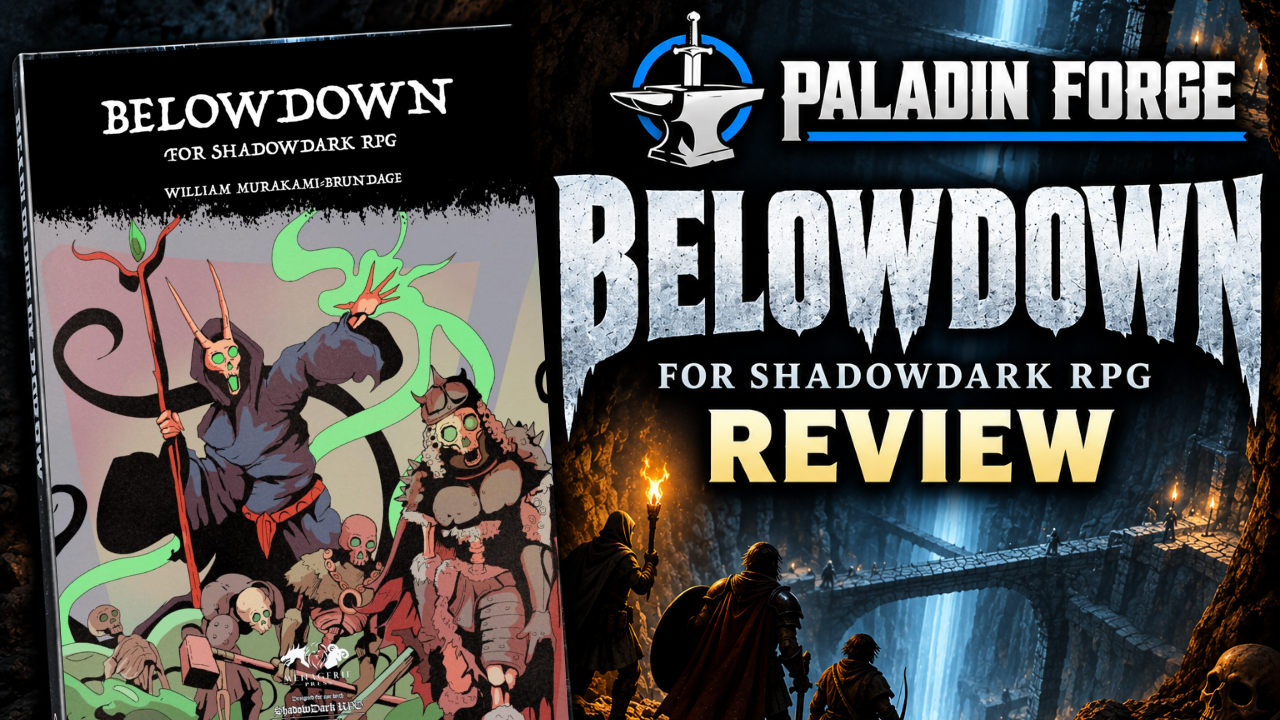
A Review of Belowdown for Shadowdark
Belowdown: A Review
I like big dungeons, but nineteen levels is a bunch.
That was one of my first thoughts upon opening Belowdown, a 121-page Shadowdark-compatible megadungeon written and designed by William Murakami-Brundage. The adventure uses the first nineteen maps from Dyson Logos’s Iseldec’s Drop, a series of small dungeon levels connected by a central shaft. Murakami-Brundage fills them with competing inhabitants, forgotten civilizations, ancient machinery, mutants, automatons, troglodytes, drow, serpent people, undead, and quite a few things that probably should have been left alone.
Belowdown ran on Kickstarter in February 2025, raising $8,898 from 425 backers against a $250 goal. I was one of those backers. Today, you can pick up Belowdown through DriveThruRPG.
Nineteen levels sound enormous because it is, but Belowdown isn’t nineteen floors the characters are expected to clear in order. Surface entrances reach Levels 8, 9, 12, 13, and 16, and Level 12 opens into the ruins of a duergar city destroyed during a war with the drow. At the bottom, Level 19 opens into the Utter Below, an endless cave world beyond the scope of the book.
Put it somewhere in a campaign, let the characters become curious about it, and see how far they are willing to go.
The Zorgtashes
The first four levels are largely the territory of three brass automatons called the Zorgtashes. Each contains a copy of Grand Magus Zorgtash’s consciousness, and each believes he is the real Zorgtash. There is a Paranoid Zorgtash, a Scholarly Zorgtash, and an Arrogant Zorgtash. They don’t like one another, which gives the Game Master more to work with.
The Paranoid Zorgtash can potentially hire the characters to destroy the other two. The Scholarly Zorgtash may trade magical knowledge with respectful visitors. Players can lie to them, bargain with them, manipulate their rivalry, fight them, or potentially do several of those things before everything goes wrong. Scholarly Zorgtash’s study also contains cube-shaped magical scrolls made from lapis lazuli, coral, and ivory.
That is where Belowdown starts giving the Game Master situations instead of simply stocking rooms with things to kill. The Zorgtashes’ mutant servants are a good example. On Level 1, two mutants scrub the floor and polish the central shaft with long-handled brushes. If they aren’t hostile, they ask whether the characters have come to pay tribute to the Esteemed Grand Magus Zorgtash.
Then there is Gargin, a squat, white-furred mutant wearing a leather apron who is sautéing onions and turnips when the characters enter his kitchen. Treat him decently and he offers them food. Mention meat and he gets angry. If things go badly enough, he attacks with his skillet.
Berserk automatons on Levels 5 and 6 separate the Zorgtashes above from the troglodytes on Levels 7 through 9. The troglodytes hate the mutants but struggle to push upward because of the automatons and the bright light. Deeper levels contain the power infrastructure used by the Zorgtashes, while drow explorers and traces of older civilizations begin appearing farther down. Each section has a reason to feel different from the one above it.
Going Down
The central shaft gives the whole adventure a physical spine and constantly reminds the players that there is more beneath them. Early on it is twenty feet wide, surrounded by polished flagstones, and covered with looping blue Reptilian mathematical runes. Light sometimes blasts upward from below, and the structures around the shaft change as the party descends.
That works especially well with Shadowdark. Darkness and dwindling resources already create pressure, and Belowdown turns depth into part of it. The alternate entrances keep the dungeon from becoming a straight march from Level 1 to Level 19. Finding one of those entrances somewhere in the surrounding world could completely change the next expedition.
The Older World Beneath the New One
The Zorgtashes aren’t the beginning of Belowdown’s history. The Reptilian runes and machinery gradually reveal that they are living inside something much older. By Level 12, the characters can encounter runes containing necromantic equations and references to an animating pool farther below. A malfunctioning glyph meant to gather the dead can create ectoplasmic wights until somebody figures out how to disable it. Nearby doors lead into the abandoned duergar city and carry warnings left by drow during the old conflict known as the Unchaining.
Layout
The layout is clean and practical. Dyson Logos’s compact black-and-white maps are easy to read, the keyed rooms stay close to the material they reference, and monster statistics and encounter information are presented where the Game Master needs them. For a dungeon this large, that straightforward presentation matters more to me than decorative page design.
Final Thoughts
The deeper the characters travel, the farther the ordinary world begins to feel from them. The eccentric Zorgtashes and their mutant household eventually disappear above, the architecture gets older, and the civilizations responsible for what the players are seeing become increasingly remote. Somewhere down there, Tolkien’s terrible little line from Moria starts feeling appropriate: “We cannot get out.”
A good megadungeon should occasionally create that feeling. It still needs humor, treasure, discovery, and mutant cooks frying vegetables, but there should come a moment when everybody realizes just how far underground they have gone. Belowdown has the structure to produce it, and reaching Level 19 doesn’t offer much comfort. Grand Magus Zorgtash is down there as a lich, but so are the doors into the Utter Below. After nineteen levels, there is still more darkness underneath your feet.
What I like about Belowdown isn’t simply its size. Size is a biggie but... What matters is whether I can imagine the rooms producing memorable play, and there is a lot here I would enjoy putting in front of players. The Zorgtashes give the upper levels personality; the inhabitants behave like inhabitants; the factions give the dungeon an understandable ecology; and the older Reptilian and viperian material makes descending feel like uncovering history rather than merely finding tougher monsters.
I would put Belowdown on the map and let the players become curious about it. Let them go down until they’ve had enough. Let them leave, find another way in, and come back.
For a megadungeon, I can think of few better compliments than that.
Post a comment