The Rings of Power: This Is What We Get for Being Fans
The Rings of Power: This Is What We Get for Being Fans
Four years ago, I wrote an article about The Rings of Power as Amazon’s grand experiment in Middle-earth was getting underway. I titled it Conan and The Rings of Power Through the Eye of the World. At the time, my argument was fairly simple: Amazon wanted its own watercooler fantasy phenomenon in the vein of Game of Thrones.
Turns out everybody is still chasing that Game of Thrones fame, even HBO, the network that created it. We have House of the Dragon (I’m Team Black, for the record), and now A Knight of the Seven Kingdoms. Apparently, the lesson Hollywood learned from the extraordinary success of Game of Thrones was that there is another fantasy property capable of becoming the show everybody talks about on Monday mornings.
My concern four years ago was that the property itself would become secondary to the television show Amazon wanted to make out of it. I wrote the piece in September 2022, made my argument, and then, for the most part, left The Rings of Power alone. I didn’t spend the next four years rage-watching it, (Nerdrotic style), or writing weekly articles cataloguing every deviation from Tolkien’s established lore. I stopped watching.
My wife, however, likes it. She started watching the series a few months ago and has spent considerable time trying to convince me to give it a chance. Every once in a while I would sit beside her and watch, and I never lasted long. It was a substantial departure from Tolkien that pulled me out. Other times it wasn’t even the lore. It was an aesthetic choice, a costume, a line of dialogue, or something that simply felt so contemporary that whatever illusion of Middle-earth the show had managed to create disappeared.
And it isn’t because either of us has some passing interest in Tolkien. My wife and I both love The Lord of the Rings. We love Tolkien. This past April 30, when we renewed our wedding vows, we did it at Thorncrown Chapel in Eureka Springs, Arkansas, with the entire celebration inspired by The Lord of the Rings. I dressed as Aragorn. My wife was a beautiful elf. Our family dressed as hobbits and assorted fantasy folk, and we made a day of it. We even held our post-renewal dinner at a place called the Rowdy Beaver, which, if that isn’t the name of a tavern where a D&D party receives its next quest, I don’t know what is.
So there isn’t any hostility toward Tolkien in our house. Quite the opposite. My wife can enjoy Amazon’s version of Middle-earth. I leave it alone.
Then I saw the dwarves.
Frodo Lives
My relationship with Tolkien goes back considerably further than Amazon Prime. I was a very small boy when my nanny took me into New York City and people had been writing Frodo Lives on the subway walls: I kept asking her what they meant. She didn’t know, but my father did.
He explained Frodo to me. He explained The Hobbit and The Lord of the Rings and told me that people had been writing Frodo Lives for years. He talked about him and my mother going to a music festival where the words seemed to be everywhere. They were painted on Volkswagen vans and scrawled across the hay bales. Later I would learn that the festival was called Woodstock. But the point is, Frodo Lives. By then Tolkien had escaped the boundaries of fantasy literature and become part of the counterculture. His characters belonged to people who had never met one another and yet recognized those two words immediately.
My father read The Lord of the Rings to me when I was a boy. I read them myself a few years later and eventually I understood what those words on the subway walls meant. Tolkien wasn’t simply popular. Middle-earth had become part of the larger world. People carried it around with them, painted it on their vans, and wrote it on walls. Decades later, I still remember those walls. I still remember Frodo Lives. And perhaps that is why what Amazon has done with Tolkien bothers me so deeply.
It matters because Middle-earth isn’t merely another collection of characters waiting around for somebody to purchase the television rights. Tolkien created something that escaped its creator and became legendary. Generations of readers imagined the Shire, Rivendell, and Moria before Peter Jackson ever pointed a camera at New Zealand. Millions of us already knew what Middle-earth felt like.
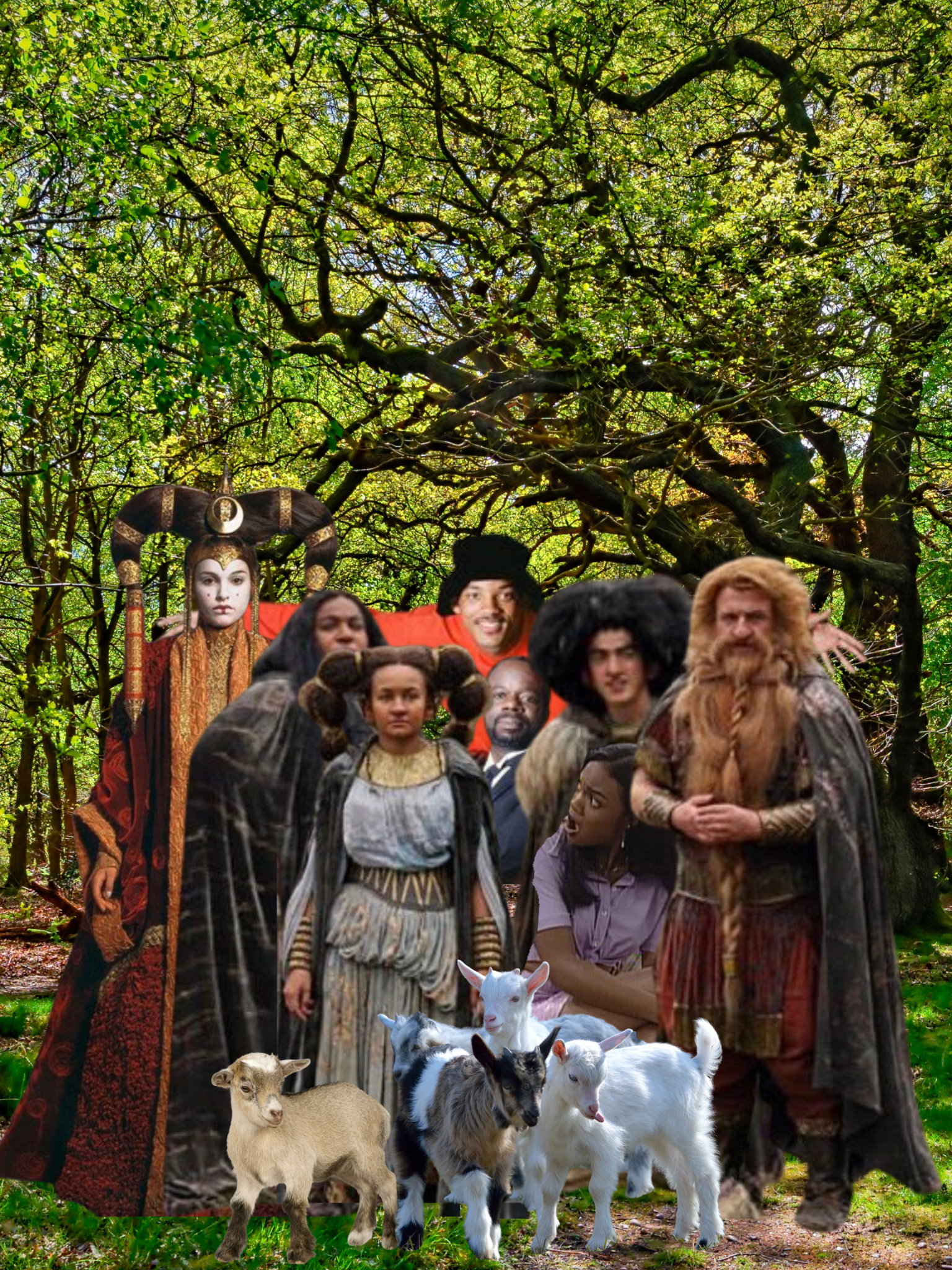
That is the inheritance Amazon purchased. And then, this week, I saw the promotional photograph of Durin and Disa with their teenage children.
I realize costume design is subjective. Adaptation requires interpretation. Tolkien did not leave Amazon a production bible specifying the exact dimensions of every dwarven nose. But come on. The teenage boy dwarf looks like he just got caught shoplifting somewhere in the Oak Cliff district of Dallas while Disa looks like she is halfway through an audition for Queen Amidala. I keep waiting for somebody from Naboo to wander in and ask where the Trade Federation went
This is Khazad-dûm? This is the House of Durin? This is what the most expensive fantasy television production in history thinks Tolkien’s dwarves should look like?
The problem isn’t simply that I dislike a wig or a prosthetic nose. The photograph crystallizes what has bothered me whenever I’ve tried watching this series. There is remarkably little visual discipline holding Amazon’s Middle-earth together. Compare it with the dwarves we already carry around in our collective imagination. There should be weight to them. Age, stone and metal. An almost geological quality, as though these people belong beneath mountains because mountains and dwarves were made for one another. Instead, I look at this photograph and see actors wearing costumes, and the spell is broken before anybody says a word.
Adaptation Is Not the Problem
I am a writer. I understand adaptation. Books and television are different mediums. Characters sometimes have to be combined. Timelines may have to be compressed. Events may need to move. Dialogue has to be invented. Tolkien himself revised his mythology repeatedly. I don’t expect a television adaptation to function as an illustrated audiobook.
Peter Jackson changed Tolkien, and some of those changes were substantial. The films largely erase the seventeen years that pass between Bilbo leaving the Ring to Frodo and Gandalf returning with the terrible truth about what it actually is. Tom Bombadil is gone, along with the Barrow-downs. The entire Scouring of the Shire is gone.
Perhaps most dramatically, Jackson fundamentally changes the Battle of the Pelennor Fields. In Tolkien, Grond breaks the Great Gate and the Witch-king rides through it to confront Gandalf, but Sauron’s army never overruns Minas Tirith. The horns of Rohan sound, the Witch-king turns back toward the battlefield, and the Rohirrim fall upon Sauron’s forces outside the city. Aragorn later arrives aboard the captured Corsair ships, not with an invincible green ghost army, but with living men from southern Gondor. The Army of the Dead had already fulfilled its oath at Pelargir and been released. Jackson’s version is spectacular cinema, but it is a massive change to Tolkien’s battle.
Those aren’t minor alterations. Some fundamentally change characters, chronology, and even the resolution of major events. Yet Jackson’s films overwhelmingly gave me the impression that the people making them were trying to enter Tolkien’s world rather than remake Tolkien’s world in their own image. They wanted dirt under the fingernails. They wanted languages, weapons, architecture, heraldry, and clothing that seemed to have existed for centuries before the camera arrived.
That is the distinction for me. Fidelity is not simply whether every event happens exactly as Tolkien wrote it. There is an enormous difference between changing something because adaptation requires choices and changing something because the writers want Tolkien’s characters to participate in the conventions of contemporary television quotas.
Which brings us to Galadriel, Sauron and Celeborn. Yes, apparently we are doing this.
Season 3 will introduce Jamie Campbell Bower as Celeborn, Galadriel’s long-absent husband. And somehow this has become a love triangle. Not according to angry Tolkien fans, but according to the showrunners themselves. When J.D. Payne and Patrick McKay were directly asked whether the relationship among Galadriel, Celeborn, and Sauron constituted a love triangle, they answered yes.
Absolutely yes.
Think about what we are talking about: Sauron, Galadriel, and Celeborn in a love triangle. Adaptation stops being the explanation because what you’re creating no longer emerges organically from the material you’re adapting. Tolkien’s characters have instead become pieces to be rearranged into familiar television machinery. We need romantic tension. We need interpersonal conflict. We need something people can argue about online Monday morning.
We need the watercooler.
Four years later, we have finally arrived at exactly what I was worried about.
The Watercooler Ate Middle-earth
Amazon did not need to make Tolkien relevant. That may be the fundamental misunderstanding underneath this entire project, because Tolkien was already relevant. His relevance survived his death, changing literary fashions, and fantasy becoming mainstream. It survived generations of adaptations and imitators, role-playing games, heavy-metal albums, and college dorm rooms. And it will continue to stay relevant because fathers will continue to pull out old copies off the shelf and read to their children.
Frodo Lives is the watercooler. It happened organically because people loved the work.
Modern entertainment companies seem increasingly convinced that cultural relevance can be manufactured if you assemble enough money, intellectual property, and social-media conversation. But Tolkien doesn’t require any of that to survive. Amazon does.
That distinction matters. The purpose of adapting Tolkien should be to bring people into Middle-earth. Instead, too often, The Rings of Power seems determined to bring Middle-earth into the contemporary world. These are not the same thing.
Tolkien’s Electrical Grid
I occasionally wonder what Tolkien himself would make of all this. Obviously none of us can know, but somewhere beneath the soil of Oxford, I suspect the old professor is rotating at a fairly impressive rate. At this point somebody should attach a length of 14/3 to him. We could probably power a small village.
I joke because what else is there to do? I don’t own Tolkien. Neither do the people who dislike The Rings of Power, and neither do the people who love it. My wife enjoys the show, and I am genuinely glad she does. I’m not interested in telling somebody else what they’re permitted to enjoy.
But Amazon possesses something that millions of people loved long before Amazon arrived. That should create a sense of responsibility. Stewardship, even. You can reinterpret Tolkien. You can adapt Tolkien. You can make choices I dislike and still create something recognizably born from Tolkien. But eventually there has to be a boundary where the people entrusted with these stories ask themselves a very simple question: Are we serving the story, or are we using the story to serve ourselves?
Because if the answer is Sauron, Galadriel and Celeborn in a love triangle while the House of Durin looks like it wandered onto the set from filming The Fresh Prince of Bel-Air, I’m increasingly confident which side of that line we’ve landed on.
Four years ago I worried about what Amazon’s search for its great fantasy watercooler show might do to Tolkien. We’ve already seen what happened to The Wheel of Time. Amazon wore Robert Jordan’s world like a skin suit for three seasons, and when the audience numbers no longer justified the expense, it shed the skin. A fourteen-book fantasy epic that took Robert Jordan much of his life to build became another expensive piece of content that Amazon tossed out.
But that’s an article for another day. Looking back at what I wrote in 2022, though, the whole thing feels almost uncomfortably prescient. I certainly didn’t have a palantír. I was simply watching Amazon pursue Conan, The Wheel of Time, and Tolkien while searching for its own Game of Thrones-sized fantasy phenomenon. Four years later, The Wheel of Time has been canceled after three seasons, and The Rings of Power is giving us Sauron, Galadriel, and Celeborn in a love triangle.
Maybe the writing was already on the wall. Or, considering Tolkien, perhaps it was on the subway wall.
The wonderful part is that Tolkien will survive this too. Long after The Rings of Power ends, some little boy will pick up The Hobbit. Somebody will encounter Gandalf for the first time, walk into Moria, or stand with Sam on the slopes of Mount Doom. Somewhere, perhaps, another kid will discover those magical words scrawled across the New York City subways.
Frodo Lives. He always will.
Post a comment