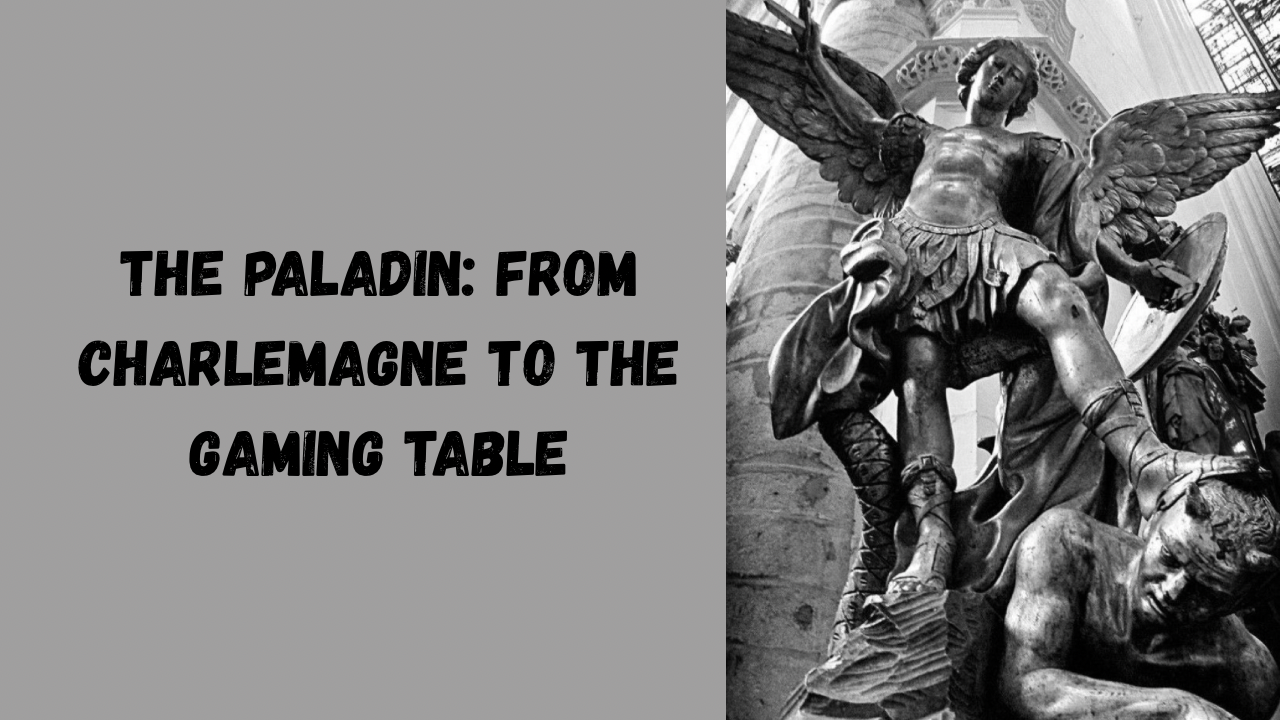
The Paladin: From Charlemagne to the Gaming Table
I named my company Paladin Forge because the word means something to me. Since I was young, I have felt compelled to protect people, defend the weak, and stand up against bullies. That conviction has sometimes brought consequences. Avoiding trouble has never seemed more important to me than defending someone who needs help. I am a Christian, and my understanding of goodness begins with Christ the King. When I call myself the paladin at Paladin Forge, I am identifying an ideal and the responsibility that comes with it. That is why discussions about what makes a paladin a paladin matter to me beyond a character sheet.
An online post recently insisted that paladins do not need to be lawful good, dismissing that restriction as stupid and pointing to blackguards, oathbreakers, and evil divine champions. Depending on the game and edition, the rules may allow those characters. But what a particular ruleset permits does not settle what an archetype means, where it came from, or what changes when its defining qualities are removed. A paladin has a history that predates Dungeons & Dragons by centuries. Understanding that history requires following the word through Christian literature and into the gaming hobby. It also requires taking seriously the moral identity that made the figure worth adapting.
Before the Character Class
The word itself did not originally mean a warrior with divine powers. As the Online Etymology Dictionary explains, English paladin came through French and Italian from Latin palatinus, meaning an official of the palace or someone belonging to it. Its linguistic ancestry concerns the imperial court, rather than a religious profession. The familiar English form appears in the late sixteenth century in connection with Charlemagne’s legendary champions. An extended meaning of heroic champion developed as well. That gives us the word’s ancestry, but the stories give us the figure fantasy readers recognize.
Those stories surround Charlemagne, particularly the legendary Twelve Peers. These traditions are often called the Matter of France, distinct from the Arthurian Matter of Britain. The Song of Roland places its heroes in an explicitly Christian moral and religious world. Roland calls upon God, seeks forgiveness for his sins, and at his death is received by angels. His service to his earthly lord exists within that larger religious understanding. Christianity supplies the story’s understanding of duty, sacrifice, judgment, and salvation.
These are literary heroes, whose stories should not be mistaken for straightforward biographies of Charlemagne’s actual companions. Their Christian identity also does not make every decision wise or every quality admirable. Roland’s courage and loyalty coexist with the disastrous consequences of refusing to summon help when Oliver urges him to do so. I think that matters whenever a morally defined hero gets dismissed as flawless or uninteresting. A character can believe in an objective good and still struggle with pride, judgment, and competing duties. Having a standard gives him something to fail at, too.
Christianity built Western civilization through the work of generations of believers, and the Christian knight belongs to that inheritance. That work included preaching, scholarship, charity, government, and the armed defense of communities. Within the Christian just-war tradition, defending others can be a moral responsibility, subject to obligations governing when and how force is used. Aggression and defense both involve force, but they serve different ends. A warrior’s willingness to fight tells me little until I know what he fights for and how he conducts himself. The paladin makes those questions part of the calling.
If Christians had been weak little pansies, we would have been a flash in the pan. We wouldn’t have lasted more than a hundred years, to say nothing of the times after the appearance of the Muslims.
Christian imagery itself contains righteous combat. In Revelation 12, Michael and his angels battle the dragon and its angels. That heavenly conflict does not supply a justification for every earthly war, but it plainly belongs to a religious imagination in which goodness can actively confront evil. The just-war tradition likewise recognizes limited circumstances in which military force can be morally justified. Mercy and restraint belong alongside courage and the willingness to defend. A Christian warrior remains responsible for his decision to act and for what he does once the fighting starts.
From Romance to Rules
One important connection between this literary tradition and fantasy gaming is Poul Anderson’s Three Hearts and Three Lions, one of the books listed in D&D’s Appendix N. I first read it as a teenager, and a few years ago some associates and I began discussing it, with some of us rereading it during those conversations. I really like the story, and Alianora, the swan maiden, has always stayed with me. Its protagonist, Holger Carlsen, belongs in any serious discussion of the gaming paladin’s literary ancestry. Roger E. Moore presented Holger as a lawful-good, fourteenth-level paladin in the May 1981 issue of Dragon, number 49. That adaptation shows how readily the character fit the class in an early D&D publication. Christian romance and modern fantasy had already supplied a recognizable figure. The game gave him statistics.
The paladin entered published D&D in the 1975 Greyhawk supplement, credited to Gary Gygax and Rob Kuntz. The original class rules allowed qualifying lawful fighters with a Charisma of at least 17 to become paladins. That requirement was lawful under the earlier alignment framework, before the familiar nine-alignment system. Healing, resistance to disease, and restrictions on wealth accompanied the character’s martial abilities. Excess wealth went to the poor or charitable and religious institutions. I like that the obligation reached into the treasure pile. Service required giving up something the character might otherwise have wanted to keep.
The standard paladin of first- and second-edition AD&D, followed by third edition and its 3.5 revision, carried the familiar lawful-good requirement. The 3.5 rules made the commitment explicit: act honorably, aid people in need, and punish those who threaten innocents. A willing evil act cost the character the class’s special abilities. I still think that is one of the clearest expressions of the class. Players could disagree about its application, and Dungeon Masters could apply it poorly. That called for judgment at the table; it did not make the underlying identity pointless.
The obligations also affected possessions and companions. First-edition AD&D required an immediate tithe of ten percent of all income to a lawful-good charitable religious institution. It barred retaining wealth beyond modest support and specified expenses, and limited the paladin to ten magic items divided among particular categories. Henchmen had to be lawful good. The 3.5 code prohibited lying, cheating, and poison, barred knowingly associating with evil characters, and restricted henchmen, followers, and cohorts to lawful good. Those are substantial restrictions, especially when the rest of the party wants the treasure and has fewer objections to the company it keeps. Whether someone enjoys playing within those limits is a fair question. The limits nevertheless gave service and restraint consequences during play.
Falling carried consequences just as concrete. Under the first- and second-edition core rules, a knowingly and willingly committed evil act ended paladinhood permanently. A knowingly committed chaotic act required confession and penance before a lawful-good cleric of at least seventh level. In 3.5, a fallen paladin lost spells and special abilities, including the special mount, and could no longer advance in the class until appropriate atonement. Weapon, armor, and shield proficiencies remained. He still knew how to fight, but the divine benefits were gone. The atonement spell required genuine repentance and could involve a quest to demonstrate it. That gave the player something to do about the failure, provided the character was prepared to acknowledge it.
The Distinction Between a Champion and a Paladin
An evil religious warrior is a coherent fantasy character. Evil gods can have devoted servants, and villains can possess courage, discipline, loyalty, and supernatural power. None of that makes their purpose righteous. Third edition’s blackguard offered an explicitly evil prestige class, including particular benefits for fallen paladins. Its abilities inverted familiar paladin features through smiting good and spreading despair. The blackguard worked as a villain partly because it turned the paladin’s abilities against everything they had served. Becoming one made the fall mean something.
Third edition also offered alternatives within the paladin name. The 3.5-era variant rules presented paladins of freedom, tyranny, and slaughter, respectively chaotic good, lawful evil, and chaotic evil. Each followed a particular code, and the text suggested calling the standard version a paladin of honor when using these alternatives. So yes, third edition permitted alternative-alignment paladins through optional rules. Its standard class nevertheless retained the lawful-good requirement. I prefer the clearer distinction offered by the blackguard, but both facts belong in an accurate account of the edition.
Look at what the two classes actually did. Third edition’s paladin detected and smote evil, healed through Lay on Hands, resisted fear through Aura of Courage, and received a special mount. Give the blackguard Detect Good, Smite Good, and an Aura of Despair that weakened nearby enemies’ saving throws, and the reversal was hard to miss. Its spell list included Corrupt Weapon, empowering its champion’s attacks with evil. I think that worked. A fallen paladin could turn powers resembling his former gifts against the people he once should have protected. Whatever justification he offered, Smite Good was a fairly blunt admission.
Fourth edition broadened the core class beyond lawful good while requiring the paladin’s alignment to match the chosen deity’s. Its Player’s Handbook acknowledged evil paladins as predominantly villains. Fifth edition removed the universal lawful-good requirement and emphasized sacred oaths. That is where I start asking what the oath actually requires, because devotion alone tells me very little. The 2014 class description still presents champions of righteousness who oppose evil, protect innocents, and heal the injured. The Oath of Devotion names honesty, courage, compassion, honor, and duty. Those are obligations I would expect a paladin to uphold, and I’m glad the book spells them out.
Much of the 2014 class’s mechanics remained familiar as well. Divine Sense located celestials, fiends, and undead rather than reading every creature’s alignment. Divine Smite dealt radiant damage, with an additional die against fiends and undead. My preference still leans toward abilities that protect companions, and Aura of Protection gave nearby allies the paladin’s Charisma bonus on saving throws. Lay on Hands and Aura of Courage added healing and resistance to fear. There is plenty of the traditional paladin in that combination. Fifth edition also retained guidance for breaking an oath, including confession and forgiveness, with an unrepentant offender potentially required to abandon the class or adopt the Oathbreaker option at the DM’s discretion. More was left to the DM, certainly. The oath still gave the DM grounds to say the character had gone too far.
Joe Manganiello’s Arkhan the Cruel gives that distinction a recognizable face. A dragonborn Oathbreaker devoted to Tiamat, Arkhan retains the martial power and religious conviction of a divine champion while directing them toward an evil purpose. His devotion does not make that purpose righteous, any more than his courage makes him good. The word Oathbreaker identifies a rupture with the ideal the paladin traditionally represents. Fifth edition can accommodate the evil champion while still naming the moral distinction. Arkhan demonstrates that conviction and power alone are insufficient to make a warrior virtuous.
D&D adapted this Christian literary figure to worlds with invented religions. Its paladins can serve fictional gods, and later interpretations emphasize the power of sacred oaths. A D&D character need not literally worship Christ to belong to the class. That adaptation makes sense to me. The question is what survives the move, and many recognizable obligations and qualities did survive. Changing the religious setting did not erase the ancestry, or the reasons players attach a particular moral meaning to the name.
More Than One Way to Adapt an Archetype
Among other games, Castles & Crusades takes an approach close to my own preference. Its Players Handbook requires lawful-good alignment and a code centered on honor, aid to those in need, respect for legitimate authority, and the protection of innocents. Knowingly associating with evil characters is forbidden, while abandoning the calling, willingly committing evil, or grossly violating the code costs the paladin’s abilities, including the divine mount. Healing, disease immunity, detecting and smiting evil, and a protective divine aura reinforce those obligations. Aura of Courage extends protection to companions by strengthening their resistance to fear. The game gives a clear account of what the paladin is expected to do and what happens when he abandons it. That clarity appeals to me.
Pathfinder’s second edition took a different approach to naming. It used champion as the broader class name, with the lawful-good paladin distinguished from other causes, as Paizo discusses in its champion remaster preview. I appreciate that separation. Several divine-warrior identities can exist without asking the same name to carry every moral commitment. Another game goes directly back to the literature: Paladin, published by Chaosium, adapts the King Arthur Pendragon rules to Charlemagne’s legendary champions. Designers have room to broaden the available characters or return to the original setting. Either way, the names deserve some thought.
The original Adventurer Conqueror King System, through its Player’s Companion, works within Law, Neutrality, and Chaos. Paladins must remain Lawful, and changing to Neutral or Chaotic alignment costs their class powers. Returning to Law and atoning, potentially through a quest or spell, can restore them. The book separately presents the Chaotic anti-paladin, and a fallen paladin who embraces Chaos may become one at the Judge’s discretion. Changing allegiance means crossing into a different calling. ACKS II further develops the paladin as a defender of civilization, combining protective and healing abilities with religious military leadership. That includes a morale bonus for troops of the same faith and the eventual ability to attract soldiers and fellow paladins to a fortress. I like that the responsibility grows beyond the adventuring party. Eventually, other people are depending on this character to lead.
Thirsty Sword Lesbians gives us “Gal Paladins,” with a rival religious order serving a goddess called Repressia and a knight named Dame Chastity who hurts innocents “for their own good.” Subtle stuff. Dame Chastity is a villain because she harms innocents. Carrying the name of a virtue does not make her virtuous. A real paladin would show up to defend those innocents, and Dame Chastity would be dealt with. Cruelty masquerading as faith serves evil, regardless of whose holy symbol it wears. They’ve written a false champion betraying the virtues she claims to serve, then treated the betrayal as an indictment of the virtues.
For me, a useful character restriction gives a player something specific to play. A threatened village, a captive enemy, an unjust command, or an opportunity for easy profit can test the paladin’s commitment. His obligations ought to matter when keeping them costs him something. Sometimes duty requires mercy, and sometimes it requires standing between an aggressor and the person he intends to hurt. A good Dungeon Master can make those decisions consequential without engineering impossible moral traps. The player has responsibilities, too, including portraying conviction while respecting the other people at the table.
Why the Ideal Matters to Me
In 2004, I worked at Prime 112 in Miami Beach. After work one night, a group of us went to Ted’s Hideaway, a little dive bar around the corner. I lived across the street in a one-bedroom apartment right on the beach, and the restaurant staffs in the area were friendly with each other. Servers, bartenders, cooks, and other employees gathered there after their shifts. I was sitting with two women who tended bar where I worked when a large man approached and untied my shoe. Whatever reaction he expected, I brushed him off. Later, the same man began picking on a food runner from another restaurant. I cannot remember the runner’s name, but he was a small man, perhaps five-foot-five or five-foot-six. The larger man kept bullying him and told him he should not even be talking because he was so small. That offended me, because being smaller did not make him less entitled to speak or enjoy the evening. The confrontation eventually moved outside, where the man confronted me, and I knocked him out. I also ended up having to attend anger management.
What stayed with me was the larger man’s assumption that his size entitled him to humiliate someone smaller. I could ignore him untying my shoe, but watching him repeatedly bully that food runner brought a different reaction. Being able to overpower someone does not give you authority over his dignity. That conviction helps explain why the paladin has always appealed to me. Strength carries obligations toward people who have less of it, including the willingness to intervene when intervention has consequences. Courage, judgment, and responsibility all belong to that obligation.
I have made that understanding concrete in my own publishing. My Shadowdark Paladin class, available through DriveThruRPG, requires lawful-good alignment. It offers no alternative alignment for someone who wants the class with a different moral commitment. That is a deliberate choice about the character those rules represent. The requirement gives the player a standard to uphold, including when another course would be easier or more profitable. Its commitment to goodness is part of what makes it a paladin.
I chose Paladin Forge because I believe that responsibility is worth taking seriously. My faith gives it a foundation, and Christ the King is the authority I acknowledge in my own life. Identifying with the ideal means accepting a standard against which my own conduct can be judged. At the gaming table, that same ideal gives us opportunities to portray courage, service, sacrifice, mercy, and the willingness to defend others. Those obligations are part of why I want to play the character in the first place. They are also why I chose the name for my company.
Post a comment