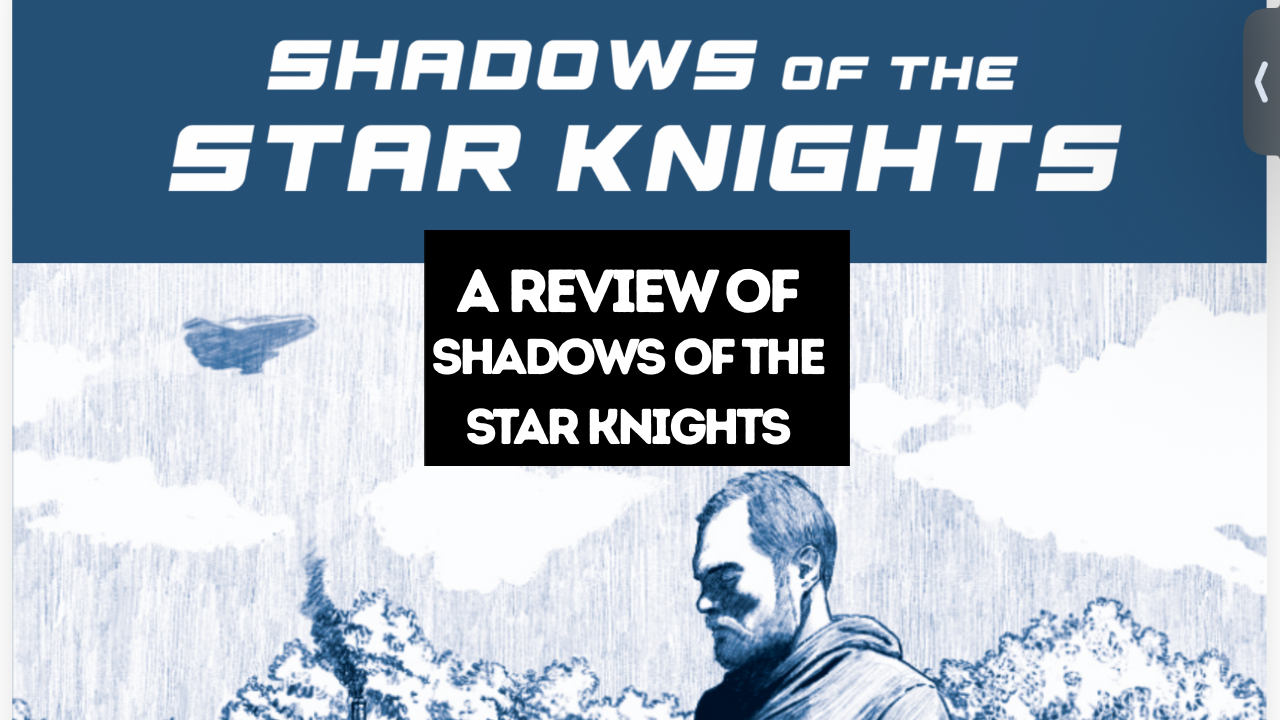
A Review: Shadows of the Star Knights
Dreams are extremely important. You can’t do it unless you imagine it.
Review: Shadowdark in a Galaxy Far, Far Away
Before we begin, a brief disclosure: I backed the Shadows of the Star Knights Kickstarter campaign, which raised $2,340 from 196 backers against a $600 goal. I came to this book already familiar with the system beneath it. Readers looking for my assessment of the core game can find it in Shadowdark: A Review.
Shadows of the Star Knights: Harry Stamford and Small Mount Studios invite Shadowdark players beyond the familiar dungeon and into a much wider galaxy. This is not a licensed Star Wars role-playing game, nor does it pretend to be. It is an 88-page, self-contained adaptation built to recreate the older, rougher, and more adventurous spirit of a certain beloved space opera.
The influences are proudly displayed: laserswords, an invisible Aether binding the universe together, fallen orders of mystical knights, masked villains, galactic empires, desert worlds, and criminal slug-lords. There is no mystery about what inspired the game. The important question is whether all that affection produces something worth playing. For the most part, it does.
The book’s greatest strength is its scope. Rather than offering a few new classes and weapons, Shadows of the Star Knights supplies the framework for an entire science-fantasy campaign. Players receive nine species and ten classes covering nearly every expected role. Engineers repair machines, hunters track targets, medics preserve lives, politicians manipulate officials, and scoundrels shoot first.
The Guardian, Initiate, and Mystic wield the Aether from different directions. Guardians are armored warriors, Mystics dedicate themselves to supernatural power, and Initiates stand between the two. Alongside the conventional classes, they allow a group to create anything from a rebel strike team to a band of smugglers, bounty hunters, or wandering knights.
These options remain recognizably Shadowdark. Abilities are concise, weapon and armor permissions are straightforward, and randomized talent tables replace elaborate character-building trees. Science-fiction games can easily become engineering manuals with character sheets attached. Stamford avoids that trap.
The Aether system is the book’s most ambitious mechanical addition. Powers are divided among Neutral, Noble, and Evil disciplines, while a slider tracks the character’s moral position. Particularly noble or evil actions move that character along the scale, granting bonuses to powers aligned with that conduct and penalties when drawing upon the opposing side.
This gives moral decisions mechanical weight. An Aether user cannot torture prisoners, execute helpless enemies, and continue invoking noble powers without consequence. The abilities themselves cover the expected ground, allowing characters to move objects, sense emotions, heal allies, compel minds, unleash lightning, or inspire terror. Each has three degrees of mastery, with the difficulty falling as the character progresses.
Because terms such as “particularly noble” require interpretation, the system depends upon an engaged referee and a shared understanding at the table. That subjectivity is not necessarily a weakness. Morality should not always be reduced to a sterile checklist, but groups should establish their expectations before an Aether character’s effectiveness depends upon those judgments.
Three Eras of Play
The Old, Imperial, and Post-Imperial Eras correspond broadly to the decline of a galactic confederation, the reign of an oppressive empire, and the unstable years after its defeat. Each supports a different campaign: political intrigue before the fall, resistance under tyranny, or conflict with warlords and resurgent dark cults.
These sketches provide direction without forming a developed setting. There is no substantial gazetteer of planets, governments, trade routes, or sectors. Instead, referees receive factions, adversaries, encounter tables, and broad historical conditions from which to build their own galaxy. Creative groups may welcome that freedom, while those seeking an established universe will have more work ahead of them.
Nearly twenty pages are devoted to enemies and prominent characters. The bestiary includes battle bots, bounty hunters, Imperial soldiers, rebels, slavers, alien predators, dark knights, and several enormous monsters. Their stat blocks are economical, usually relying upon one or two distinctive abilities rather than pages of conditional actions.
The “Heroes” section is more playful. Hank Loner, Shakalakka, Tim Shinobi, Guuda, and Lance Startrotter are famous space-opera characters wearing novelty mustaches. The names range from amusing to groan-inducing, but the joke is plainly intentional. Even referees who rename them gain a useful collection of ready-made allies and villains.
Two Adventures Ready for the Table
The Jaws of Jenka sends first- or second-level characters aboard a criminal vessel to rescue one of the last Star Knights before he can be delivered to Imperial authorities. Three compact ship levels carry the party toward a confrontation aboard a failing vessel. The scenario offers room to sneak, deceive, investigate, loot, fight, and escape, although locating a key card creates a fairly linear middle section. Its full-color maps are clear, attractive, and practical at the table.
Glowing Darkness, designed for third- or fourth-level characters, takes the party to a frozen moon in pursuit of Malryn, an aspiring Dark Lord who has stolen an ancient vibroblade. The crystal cave combines poor visibility, environmental hazards, traps, hostile wildlife, cultists, and a final battle. The party must also decide whether to kill Malryn under the original contract or take him alive for questioning by the Star Knights.
The reward attached to that decision could use clarification. The text appears to charge each player one thousand credits for calling the Knights to collect Malryn, which makes mercy unusually expensive. A referee can settle the issue quickly, but it would be worth deciding before the choice reaches the table.
Neither adventure attempts to revolutionize scenario design. Both provide focused missions that demonstrate the rules, introduce the atmosphere, and can be prepared without an enormous investment of time.
Jan Jetmar’s graphic design uses a clean two-column layout, strong section dividers, generous white space, and restrained color coding. Jeffrey Koch’s cover immediately communicates the genre while giving the book an identity of its own. The entire package looks deliberate and professional.
Shadows of the Star Knights understands both its inspiration and the virtues of the system carrying it. Its greatest success is translating cinematic space opera into Shadowdark without loading the game with excessive rules. Its greatest limitation is that the galaxy remains more recognizable than original. The book provides a sturdy vessel, but the referee must still decide where it will travel.
That is a fair exchange for groups that already know the kind of stories they want to tell. If your table has dreamed of exchanging torchlight for glowrods and longswords for laserswords, Shadows of the Star Knights can take you there.
Post a comment