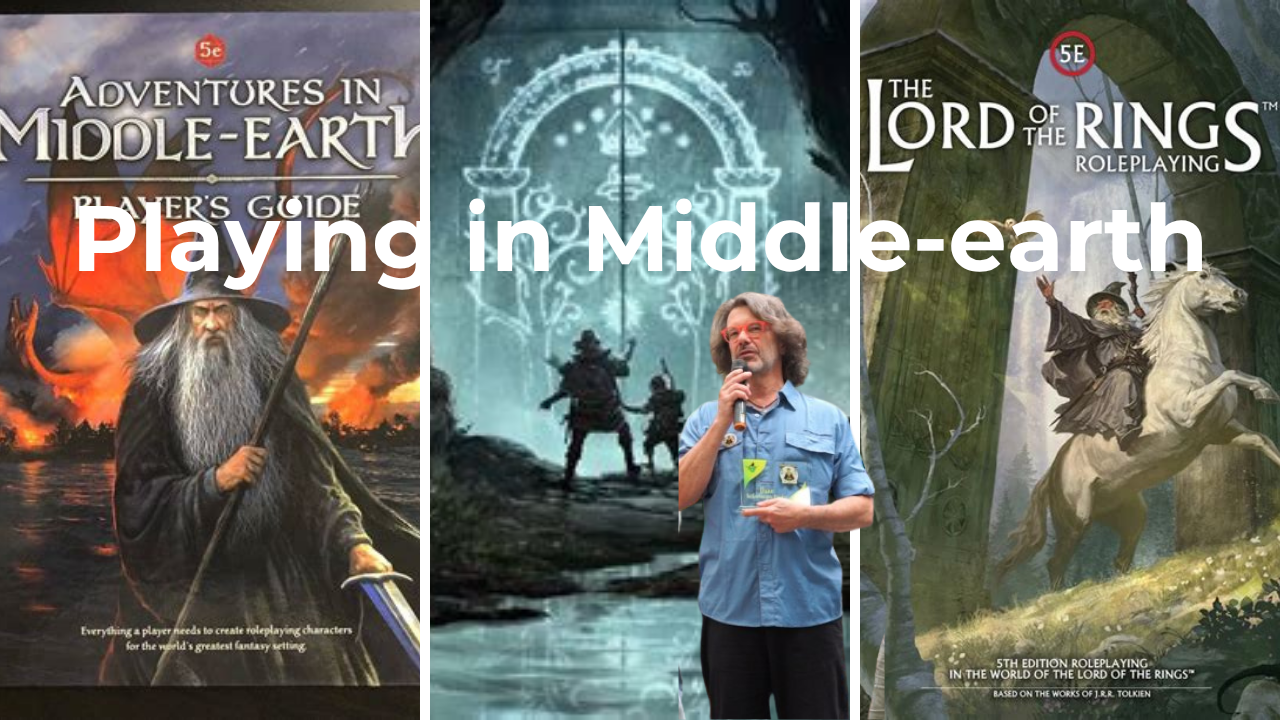
Playing in Middle-Earth
Playing in Middle-earth
Sometimes the credits tell a better story than the cover.
A couple of years ago I sat down at a crowded table, six players and a game master, and played Lex Arcana without noticing that two of the men behind the original 1993 game were Francesco Nepitello and Marco Maggi. I simply hadn’t looked at the credits. I should have.
Follow those two names and a through-line appears. Nepitello and Maggi were RPG designers long before The One Ring. Lex Arcana, created with Leo Colovini and Dario De Toffoli, came out in 1993. By the late 1990s the market had pulled Nepitello back toward board games. He never stopped being a roleplayer, but he and Maggi spent the next years accumulating a different set of tools.
From the wargaming table to Middle-earth
More than a decade after Lex Arcana, they joined Roberto Di Meglio on War of the Ring, published in 2004. Nepitello has said his serious gaming began with wargames, and that habit of mind never quite left. He and Maggi have pointed to Ted Raicer’s Paths of Glory and the card-driven wargame tradition: games that braid armies and logistics with narrative events. The problem, applied to Tolkien, was how to keep strategy and the Fellowship on the same board.
I don’t want a straight line from Lake Geneva to Venice. Different generations, different cultures. The echo is still hard to miss. Designers trained on campaigns and terrain were again asking how individual characters and a long journey might sit inside a larger war.
For Nepitello and Maggi the path was almost circular. They started as roleplayers, moved professionally into strategy games, carried RPG instincts with them, and used War of the Ring to show they could turn Tolkien into mechanics without turning him into generic fantasy. That experience followed Nepitello back to roleplaying. Talking later about The One Ring’s Journey rules, he described arriving with a board-game designer’s taste for structure. Travel would not be empty space between encounters. The road itself would have rules.
By the time a new Middle-earth RPG became possible, they were not two designers handed a famous license. They already knew the peculiar problem at the center of any Tolkien game: how do you make Middle-earth playable without making it ordinary?
The One Ring, today
I watched Francesco Nepitello and Tomas Härenstam discuss what comes next for The One Ring Second Edition. Gondor and Rohan arrive in The White Tower and the Hall of Gold. Creatures Strange and Foul finally give the line a dedicated bestiary. The core rules are being lightly revised, remaining compatible with the existing Second Edition books. The campaign heads to BackerKit on September 22.
Listening to Nepitello talk about where the game is going sent me back to where it came from.
Free League is again publishing the same Middle-earth in two systems. The White Tower and the Hall of Gold has a 5E counterpart in Realms of the South. Creatures Strange and Foul becomes Of Orcs and Evil Things. That pairing is not a Free League invention. It runs through Adventures in Middle-earth, Cubicle 7, Sophisticated Games, and the first edition of The One Ring and through a design habit Nepitello and Maggi had been forming for years. You can build a game specifically for Middle-earth without demanding that everyone enter through the same door.
Building The One Ring
The original game arrived in 2011, after an earlier false start. Nepitello has described Spanish publishers spotting the opening once Decipher’s Lord of the Rings RPG ended. War of the Ring and an existing relationship with Sophisticated Games, the license holder, put Nepitello and Maggi in position to pitch. The Spanish partners withdrew. Cubicle 7 became the publisher.
The credits are useful here. Nepitello is writer; Nepitello and Maggi are designers; Sophisticated Games and Cubicle 7 are the publishing arrangement. It is easy, looking back, to call this “the Cubicle 7 version.” It was more than that. Sophisticated Games held the foundation. Nepitello and Maggi sat at the center of the design.
They did not want another fantasy RPG with Tolkien names pasted on. Middle-earth is dangerous, but The Lord of the Rings is not a sequence of rooms with monsters in them. People walk. They tire. They get lost. They sit by fires and decide whether to trust strangers. Fellowship and hope are not flavor text. Nepitello has said he and Maggi generally start from a theme rather than from a mechanic in search of a home. The rules should disappear into Middle-earth, not the other way around.
There was also a practical fact: a great many Tolkien fans already spoke Dungeons & Dragons. That is how Adventures in Middle-earth happened.
Middle-earth in 5E
Adventures in Middle-earth took ideas from The One Ring and recast them in the fifth edition. It was a Cubicle 7-era project, with Nepitello involved. Maggi is thanked in the book; he is not the lead designer of the 5E adaptation.
I know the game from the table, not only the credits. My Ranger went into Mirkwood to hunt a werewolf and nearly died for it. The Scrying Dutchman, playing a dwarf fighter, held the beast back. That gave Rob, (Pulp Hummock), author of Gods of the Forbidden North, time for his Hobbit to drag my character clear. Rob threw himself into that Hobbit. The wilderness felt dangerous, the monster felt frightening, and survival came down to the people traveling with me. When I ranked the RPGs I had been playing in 2023, Adventures in Middle-earth came second.
The two approaches did not need to compete. The One Ring asked what kind of game you would build for Tolkien. Adventures in Middle-earth asked how much of that feeling could travel into a system millions of people already knew.
The publisher changed. The design did not.
In November 2019 Cubicle 7 announced it was ending its agreement with Sophisticated Games over unresolved contractual differences. Publication of The One Ring and Adventures in Middle-earth would stop. The Second Edition then in development would not come out under Cubicle 7.
The license did not simply hop from one logo to another. Sophisticated Games remained. So did Nepitello. In 2020 Free League announced a partnership with Sophisticated Games to publish Middle-earth RPGs, with Nepitello continuing as lead designer. That word matters. Free League was not acquiring a setting and then hunting for an author. The announcement reads less like a new game than like an existing one under a new roof.
The result is The One Ring Second Edition: Nepitello as lead writer, Nepitello and Maggi as designers. It is a continuation of the game they had already spent years making.
I had been collecting the Cubicle 7 First Edition line before any of that. I have Rivendell and Bree on the shelf, the full PDF library digitally. When Second Edition came to Kickstarter in 2021, I was not discovering the game. I backed the core book and the Shire box with its cloth map. Later I bought The Lord of the Rings Roleplaying core book and the 5E Starter Set, then both versions of Moria and their cloth map, then Keepers of the Elven-rings beside Realms of the Three Rings.
Part of that is curiosity: how the same material changes between systems. Part of it is simpler. I play The One Ring online. At home, with my sons or friends, 5E is the common language. I don’t need one system to defeat the other. Neither, apparently, does the bookshelf.
The 5E conversion of Second Edition is The Lord of the Rings Roleplaying. Nepitello remains lead writer. Michele Garbuggio is credited with the conversion. The book identifies itself as based on The One Ring by Nepitello and Maggi. Maggi belongs to the design lineage; that is not the same as saying he designed the 5E adaptation. The same distinction is held for Adventures in Middle-earth.
The First Edition had one 5E door. The Second Edition has another. Different publisher, different edition, same idea: a system built to feel like Middle-earth, and a second entrance for people who already speak D&D.
What the two games are for
The One Ring Second Edition does not play like ordinary Dungeons & Dragons. Combat exists, but Tolkien’s heroes spend as much time traveling, getting lost, and deciding whether they have the strength to continue. Journeys, fellowship, and councils are not interruptions between adventures. They often are the adventures. Nepitello has compared journey rules in a Tolkien RPG to space-travel rules in a science-fiction game: not a wargame grafted onto roleplaying, but structure where the source material needs it.
The Lord of the Rings Roleplaying has a different job. It keeps journeys, councils, Shadow, and Middle-earth’s restrained magic, then sets them on an engine millions of players already understand. Tables pick tools. Mine do. That does not require a loyalty test.
Back to 2026
Second Edition is not being retired. The White Tower and the Hall of Gold takes the game into Gondor and Rohan. Creatures Strange and Foul is the missing bestiary. The forthcoming core book is a light revision of the Second Edition rules, not a newly announced Third Edition. Beside those books, the other road stays open: Realms of the South and Of Orcs and Evil Things.
The September 22 BackerKit campaign is the next stage of a line that runs through Free League, Cubicle 7, Adventures in Middle-earth, the original The One Ring, War of the Ring, and those Lex Arcana credits I once ignored.
Keep the thing people already love. Build another entrance beside it. Players who want a system constructed around Tolkien can play The One Ring. Players who want Middle-earth in fifth edition can play The Lord of the Rings Roleplaying. One does not require the disappearance of the other.
Publishers have changed. Editions have changed. The 5E adaptations have changed. The question is: how do you give people Middle-earth to play in without losing Middle-earth along the way?
More than thirty years after Lex Arcana, more than twenty after War of the Ring, and fifteen after the first The One Ring, Nepitello and Maggi are still helping answer it.
An Additional Reference: The One Ring and Its 5E Counterparts
Free League does not always keep the same title across systems, which makes the pairings easy to miss.
|
The One Ring, Second Edition |
The Lord of the Rings Roleplaying 5E |
|
The One Ring Core Rules |
The Lord of the Rings Roleplaying Core Rules |
|
Loremaster’s Screen & Rivendell Compendium |
Loremaster’s Screen & Rivendell Compendium |
|
Ruins of the Lost Realm |
Ruins of Eriador |
|
Tales from the Lone-Lands |
Tales from Eriador |
|
Moria: Through the Doors of Durin |
Moria: Shadow of Khazad-dûm |
|
Realms of the Three Rings |
Keepers of the Elven-rings |
|
Hobbit Tales |
Shire Adventures |
|
Hands of the White Wizard |
Trials of Saruman |
|
The White Tower and the Hall of Gold (forthcoming) |
Realms of the South (forthcoming) |
|
Creatures Strange and Foul (forthcoming) |
Of Orcs and Evil Things (forthcoming) |
0 Comments Add a Comment?