Inspiration
The People Who Built My Imagination
Long before Paladin Forge existed, before I thought seriously about publishing tabletop games or writing fantasy for a living, there were writers, artists, and game designers whose work quietly established what I thought this stuff was supposed to feel like.
Some came from comics. Some came from fantasy. Others came from that strange little company in Lake Geneva that managed to turn dice, graph paper, monsters, and imagination into a booming industry.
I actually wrote about several of these people years ago in college. Looking back at that paper now, the names still make sense. Frank Miller was there. Wendy and Richard Pini were there. Geoff Johns and Alan Moore were there. At the time I was writing about people I admired in the visual arts industry, but reading it again all these years later, I realized I was really writing about influence. These were people who helped shape my ideas about storytelling, fantasy, and what fictional worlds could be.
There are a couple of people missing from that old paper, though. Now that I’m writing and publishing adventures through Paladin Forge, those omissions are pretty obvious.
Frank Miller: The Dark Knight
The Dark Knight Returns was the first graphic novel I remember reading. I was about ten years old, and until then Batman mostly meant the colorful, campy television version from the 1960s. My older brother had comics around, and once I got into them, Miller’s Batman was unlike anything I’d seen before.
His Gotham was dangerous. Batman was battered, obsessive, and human. The world around him felt like it had consequences. At ten years old I didn’t have the vocabulary to talk about tone, characterization, or worldbuilding, but I understood what Miller was doing on an instinctive level. He made something fantastic feel real.
Years later, I can see how much that lesson stuck with me. Fantasy doesn’t have to be realistic. We’re talking about dragons, superheroes, elves, magic, and people crawling around underground ruins looking for treasure. But the characters living inside those worlds should believe they’re real. Their decisions should matter, and the world should have some weight.
That’s something Miller taught me before I even knew I was learning it.
Wendy and Richard Pini: Fantasy You Could Live In
My next trip through my older brother’s collection brought me to Wendy and Richard Pini’s ElfQuest. I loved those books as a kid, and I still have a tremendous amount of affection for them today. The high fantasy setting pulled me in immediately, and of course there was the fact that the elves rode wolves. When you’re a boy in the 80s, that’s all the sales pitch you need.
What stayed with me, though, was the world itself. ElfQuest felt inhabited. There were relationships, histories, loyalties, and cultures underneath the adventures. The characters weren’t simply standing around waiting for a story to happen to them.
That’s an idea I’ve carried with me into my own work. A fantasy setting shouldn’t exist merely because the adventure needs somewhere to happen. The village should have been there before the adventurers arrived. People should have problems that have nothing to do with the player characters. The old road should lead somewhere. The abandoned tower should have a reason for being abandoned.
A good fantasy world should give you the feeling that you could leave the main characters behind, walk twenty miles in another direction, and find another story waiting for you.
Geoff Johns: Hope Matters
By the late 1990s and early 2000s, I had become somewhat disengaged from DC. A lot of the characters and storylines that I’d grown up with had started to feel bloated or stale to me. Geoff Johns was one of the writers who brought me back, particularly through his work with characters like Hal Jordan and Green Lantern.
What appealed to me wasn’t simply that Johns could write superheroes. There was a sense of hope underneath his stories that I connected with. The characters could get beaten down. Terrible things could happen. The universe could practically be coming apart at the seams, but there was still something underneath all of it worth fighting for.
That probably comes closer to what I want Paladin Forge to be than anything else on this list. I like dark fantasy. I like monsters that are actually monstrous. I like dangerous places and consequences. But darkness means considerably less when there isn’t something worth protecting from it.
Hope doesn’t make a story soft. Sometimes hope is the reason somebody picks up the sword in the first place.
Alan Moore: There Are No Walls
Alan Moore was different. The Killing Joke, V for Vendetta, The League of Extraordinary Gentlemen, From Hell, and Watchmen demonstrated just how far comics could be pushed as a storytelling medium.
I didn’t love everything equally. I admitted in the original college paper that I sometimes found Watchmen slow and clunky, and I don’t see any reason to pretend otherwise now. Admiring somebody’s work doesn’t require treating everything they created as sacred.
What I took from Moore was possibility. He could take familiar genres and ideas and push them somewhere unexpected. He showed what could happen when somebody stopped worrying quite so much about what a comic book was supposed to be and started asking what else it could be.
That’s a lesson that applies just as well to tabletop role-playing games. There are traditions worth preserving, but the medium doesn’t have to remain frozen in the form we inherited. Somebody had to be the first person to try every idea that we now consider normal.
Erol Otus: The Picture That Still Makes Me Want to Go
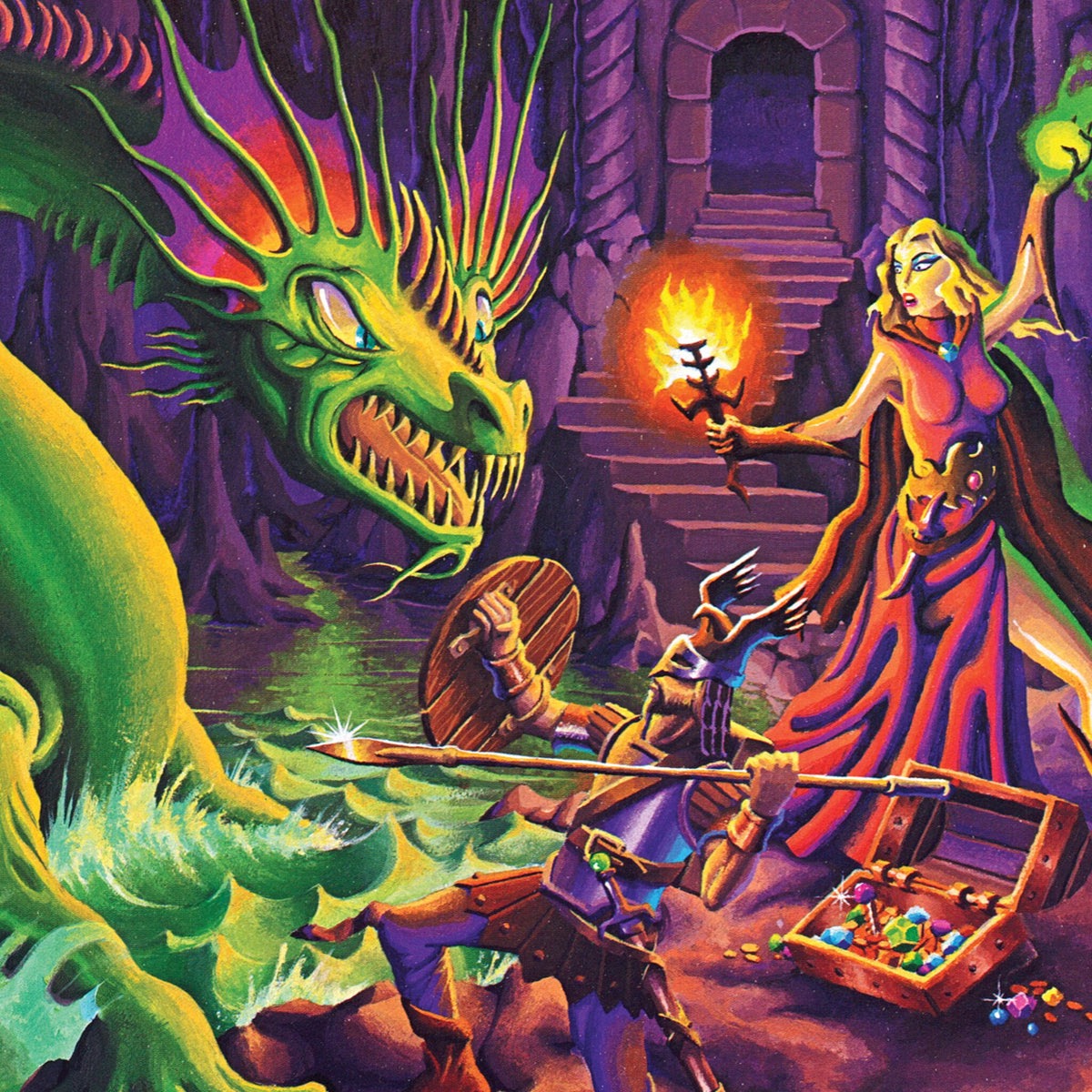
There are pieces of fantasy art that I appreciate because they’re technically great, and there are others that have been with me for so long that I can’t really separate the artwork from my memories of being a kid. Erol Otus’ cover for the 1981 Dungeons & Dragons Basic Rulebook is one of those.
I was around six years old when that image became part of my world. Obviously, at six I didn’t know anything about Erol Otus. I didn’t know anything about TSR as a company or understand how many different writers, artists, and designers were responsible for creating Dungeons & Dragons. I just knew what I saw on that red cover: a dragon, an adventurer with a spear, a strange woman holding a torch, and a staircase leading up into the darkness.
More than forty years later, I can still look at that cover and immediately want to play D&D.
That’s probably the greatest compliment I can give it. There are newer fantasy paintings that are more technically polished, more realistic, and infinitely more detailed, but they don’t have that effect on me. Otus’ cover doesn’t just show me a fantasy scene. It makes me wonder what is beyond it. Where does that staircase go? What’s in the next room? What brought these people down here in the first place? Are they going to survive that dragon? Somewhere along the way, you stop looking at the picture and start creating the rest of the adventure yourself.
I think that’s part of what the best tabletop RPG art is supposed to do. It shouldn’t explain everything. It should give you enough to get your imagination moving and then get out of the way. When I look at that old Basic cover, I’m not really thinking about art history or TSR history. I’m six years old again and I’m ready to grab some dice, roll up a character, and find out what’s at the top of those stairs.
We spend a lot of time worrying about rules, encounters, maps, layout, and all the other pieces that go into making a tabletop RPG product. All of those things matter. But before any of them matter, you have to make somebody want to go on the adventure.
Erol Otus did that to me with one picture when I was six years old.
He still does.
What They Left Behind
Looking back at the college paper that started all of this, I don’t think influence means imitation. I don’t want to write Frank Miller’s Batman. I don’t want to recreate ElfQuest. I don’t want to write Geoff Johns’ Green Lantern or Alan Moore’s Watchmen.
Paladin Forge doesn’t need to recreate TSR either.
What interests me now is what I carried away from all of them.
Miller showed me that the fantastic can still have weight. Wendy and Richard Pini showed me that imaginary worlds should feel like people actually live in them. Johns reminded me that darkness and hope aren’t opposites, and that sometimes one gives the other meaning. Moore showed me that the boundaries of a medium are usually farther away than we think. Otus showed me that a single piece of art can open a doorway in a kid’s imagination that stays open for the rest of his life. An entire generation of creators showed me what can happen once somebody walks through it.
I didn’t know any of that when I was six years old staring at a red Dungeons & Dragons book. I didn’t know it when I was ten and reading The Dark Knight Returns. I didn’t know I was studying worldbuilding when I was following elves riding wolves through the pages of ElfQuest. I was just a kid who loved this stuff.
I became a writer along the way,. Then a game designer. Eventually, I put a name on it and called it Paladin Forge.
I suppose that’s why going back and reading an old college paper like this matters to me. You can sometimes see the road you traveled a lot more clearly once you’ve been walking it for a while. These people didn’t tell me what to create, but each of them, in one way or another, showed me that creation was possible.
The people who came before us lit the forge. We don’t honor them by standing around staring at the fire.
We honor them by making something with it.
0 Comments Add a Comment?