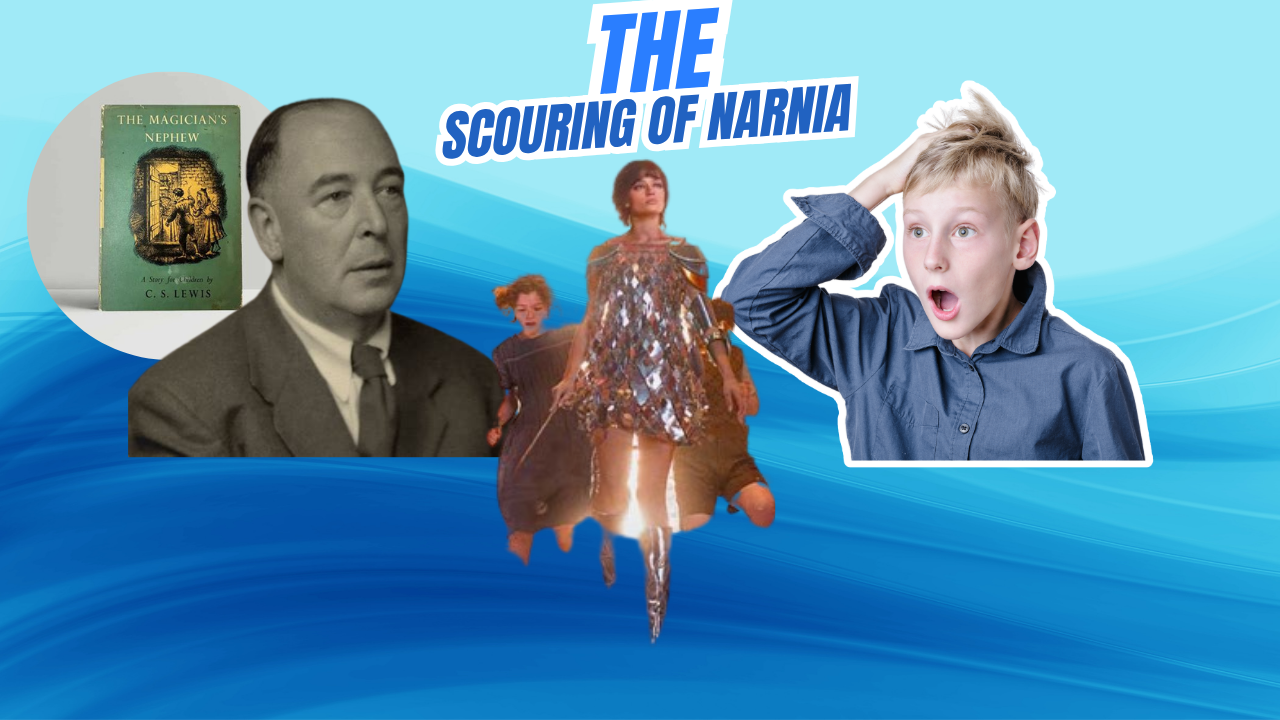
The Scouring of Narnia
He that breaks a thing to find out what it is has left the path of wisdom.
The Scouring of Narnia
Greta Gerwig has confirmed that Meryl Streep will voice Aslan in Netflix’s adaptation of The Magician’s Nephew. Gerwig told Empire that she wanted someone with age, authority, wisdom, joy, and wonder. Streep is unquestionably one of the most accomplished performers alive, but her talent is not the issue.
Aslan is not merely an impressive lion requiring an impressive voice. He is the Narnian manifestation of Christ, consistently presented as male and woven into a Christian understanding of creation, sacrifice, judgment, mercy, and kingship. Casting a woman as his voice is not an isolated experiment. It reaches into the theological center of Narnia.
Gerwig’s announced vision goes much further. Aslan has David Bowie-inspired eyes and a red stripe across his face. The creation of Narnia will carry the influence of a rock opera, although the film is not a musical, and the earthly setting has been moved from the opening years of the twentieth century to the 1950s. Gerwig has linked the film’s imagination to Bowie, Paul McCartney, David Gilmour, Pete Townshend, Jimmy Page, and Robert Plant.
Those are not unrelated adjustments. Lewis is being placed inside Gerwig’s personal collection of cultural influences until Narnia reflects its new director. Netflix did not hire her simply to bring Lewis to the screen. It gave her his Christian world as material for a Greta Gerwig film.
Not Just a Thief, but a Liar as Well
Netflix has not plainly announced that Aslan is now female. Empire still dubs Aslan “he,” and a Netflix representative reportedly pointed to that wording when asked about the character. The finished film may preserve the pronoun while giving the role to Streep.
That is not transparency. It is a convenient ambiguity. The filmmakers receive the publicity and provocation of casting a woman as Lewis’s male Christ figure while keeping enough deniability to insist that nothing has technically changed. The audience is expected to ignore what it hears because the press release retained a pronoun.
If this is a principled reinterpretation, state it and defend it. Explain why the sex of Lewis’s Christ figure no longer matters to the filmmakers or to the story. Hiding behind grammar while altering the character’s embodied presence is corporate cowardice, calculated to enjoy the benefits of transgression without accepting responsibility for it. They know the decision will bring massive opposition, so they obscure it first and call their critics unreasonable afterward.
Aslan Is Christ in Narnia
Lewis did not leave Aslan’s identity open to serious doubt. He rejected a simple one-for-one description of Narnia as allegory, but his letters explained the Christian supposition directly: if a world such as Narnia existed and required redemption, what might Christ become there? Aslan was his answer.
The Son of the Emperor-over-the-Sea sings creation into being, grants creatures speech and moral agency, sacrifices himself for a traitor, defeats death, judges the living, and leads his faithful people into the true country. Christianity is not a decorative layer placed over secular fantasy. It is the foundation that gives the story its moral order.
Aslan’s masculinity belongs to that design. Christianity does not teach that God is biologically male, but the Incarnate Christ entered as a man and revealed the Father as Father. Lewis built a king, a son, a lord, and a lion. A filmmaker may reject the significance of those choices, but a steward has no honest right to pretend they are accidental.
Misunderstood Girlboss
The same moral clarity governs Jadis. She is a queen by blood and title, but nobility of rank is not nobility of soul. In The Magician’s Nephew, she admits that she spoke the Deplorable Word and destroyed every living creature in Charn rather than surrender her throne. She regards ordinary people as lesser beings, treats mercy as weakness, and enters the newborn Narnia reaching for dominion.
Jadis may be intelligent, magnetic, beautiful, wounded, and majestic without becoming morally misunderstood. Those qualities make her corruption more terrible. What the story cannot survive is the modern reflex to excuse evil whenever it arrives in an attractive woman with a grievance. She is not dangerous because society failed to appreciate her power. She is dangerous because she believes that power places her beyond judgment.
The finished portrayal remains unseen, so there is no reason to invent scenes that haven't been shown. There is every reason to watch carefully. A production willing to destabilize the identity of its Christ figure may be equally willing to recast its satanic queen as the victim of someone else’s moral order.
Hollywood’s Mephistophelian bargain offers fame and fortune in exchange for moral surrender.
The entertainment industry understands religious boundaries when it expects consequences for crossing them. Studios know the reaction that would follow treating Muhammad as a character available for casual reinvention. They surround Jewish history, ritual, persecution, and sacred memory with consultants and institutional caution. They understand that remodeling Hindu gods can bring immediate accusations of desecration and cultural theft. Whether that restraint comes from conviction, fear, or public-relations calculation hardly matters. Hollywood recognizes that those religions are permitted to draw lines.
Then it reaches Christianity, and the lines disappear. Christ becomes intellectual property. Scripture becomes source material. Christian symbols are detached from their meaning, Christian morality is inverted, and Christian objections are dismissed as hysteria from people too primitive to understand art. The same industry that lectures the public about respecting identity suddenly discovers limitless artistic freedom when the identity belongs to Christians.
No comparable production would casually recast Muhammad, revise the covenant at the heart of Judaism, or remodel a Hindu deity through the image of a Western rock star and expect believers to applaud the director’s imagination. Wrap the act in Christian clothing, however, and contempt is marketed as bravery. That is not equal treatment. It is targeted creative disarmament based on the assumption that Christians will remain polite, purchase tickets, and accept each insult as the price of participating in modern culture.
This should surprise no one. Hollywood’s culture does not merely misunderstand Christianity. It is hostile to Christianity, hostile to Jesus Christ, and contemptuous of the people who follow Him. Christ warned his disciples that the world would hate them because it hated him first. An industry organized around vanity, appetite, inversion, and the worship of self will not remain neutral toward a faith that commands repentance, sacrifice, honor, and judgment.
Calling that machinery satanic is not theatrical exaggeration. Satan means adversary. An institution places itself in the adversary’s service when it persistently obscures Christ, reverses the moral order, and substitutes ideology for revelation. This does not mean every actor, writer, or technician consciously worships the devil. It means the institution’s spiritual direction can be recognized by its fruit. Hollywood receives a Christian inheritance and seeks to immediately supplant it. Again and again.
That replacement rarely happens through one declaration. Christ becomes a generic spiritual presence. Sin becomes trauma. Evil becomes subjective. Redemption becomes self-acceptance. Judgment vanishes and hierarchy becomes oppression. The author is praised while his convictions are emptied from his creation. The people doing it conceal the purpose because, at some level, they understand that desecration cannot bear honest scrutiny.
Adaptation Is Stewardship
Obviously, no serious reader expects a film to reproduce every page. Cinema requires compression, interpretation, and innovation. The real question is whether those choices serve the work or twist it.
This is the principle I examined in The Steward’s Hand: receiving authority over an inheritance does not confer moral ownership over its meaning. A steward stands between the creator and a new audience. His obligation is to understand before interpreting, to transmit before transforming, and to preserve what is essential even when contemporary fashion demands its removal.
Gerwig is free to make a David Bowie-inspired rock fantasy about postwar Britain, female authority, and cultural upheaval. What she is not entitled to do without fierce criticism is place C. S. Lewis’s title over that project and demand gratitude from the people who preserved Narnia for seventy-five years.
In The Return of the King, Tolkien wrote, “The Shadow that bred them can only mock, it cannot make: not real new things of its own.” The line names the temptation of an age that inherits beautiful things, resents the beliefs that produced them, and then claims creativity while cutting them away from their roots.
Aslan does not need David Bowie’s face or Hollywood’s uncertainty about sex, authority, or divinity. Jadis does not need rescuing from Lewis’s moral judgment, and Narnia does not need to apologize for being Christian. Real courage would be presenting Christ as king to an age that rejects kingship. Courage would confront an industry addicted to inversion with the unyielding reality of objective good.
Netflix has chosen the safer path: preserve the brand, remove the faith, provoke the audience, and deny that anything important has changed. Christians can see what is happening, and we should say it without apology.
You do not honor a story by erasing the truth that gave it life. You do not inherit Narnia by repainting the Lion. Christ is King, and Aslan is not raw material.
Post a comment