Dungeons & Dragons: The Movie and the Adventure Designed Around It
Dungeons & Dragons: The Movie and the Adventure Designed Around It
I knew there was an adventure connected to the 2000 Dungeons & Dragons movie. What I didn’t know was how much material Wizards of the Coast had actually built around it.
I’d always thought of it as one small promotional adventure, the sort of movie tie-in that might be interesting to look through years later but probably wouldn’t amount to much more than a curiosity. Once I started digging through the surviving material, that assumption didn’t last long.
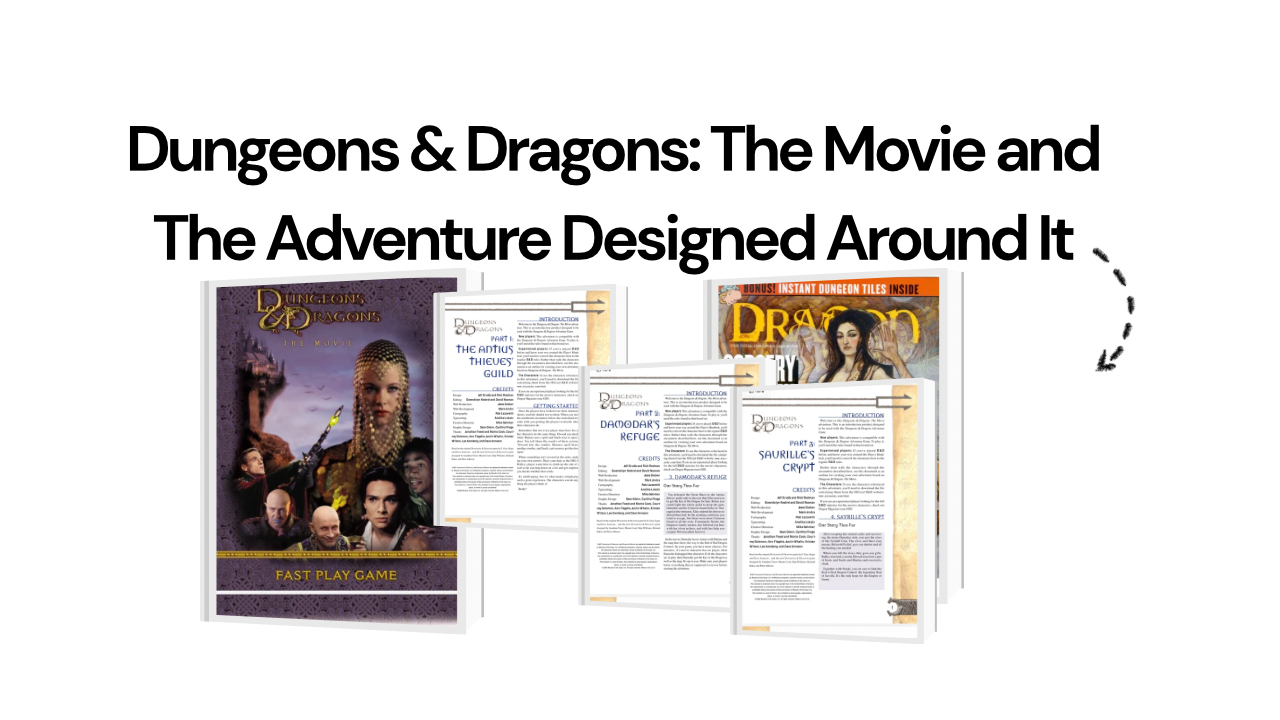
There was The Sewers of Sumdall, a self-contained Fast-Play game designed to introduce people to Dungeons & Dragons using characters from the movie. Then there was The Antius Thieves’ Guild, followed by Damodar’s Refuge and Savrille’s Crypt. Wizards distributed additional character material online. Dragon Magazine #280 supplied full Third Edition statistics for the movie characters.
What initially looked like one promotional adventure turned out to be something considerably more interesting: a path from the movie into Dungeons & Dragons.
Start With Three Six-Sided Dice
The best place to begin is Dungeons & Dragons: The Movie: Fast-Play Game, which contains The Sewers of Sumdall. The booklet describes itself as a self-contained, easy-to-learn game in which players take the roles of heroes from the film.
Wizards stripped the entry requirements about as far down as they could go. You needed some friends, pencils, and at least three ordinary six-sided dice. One person became the Dungeon Master and everyone else took one of the movie characters. You didn’t need the Player’s Handbook, and you didn’t even need a standard set of polyhedral dice.
The adventure puts the characters in the sewers beneath Sumdall while they are being hunted by Profion and Damodar’s Crimson Brigade. Its eight encounters form a small dungeon, but they’re also arranged in a way that introduces the game through play. Checks, exploration, treasure, healing, combat, and traps arrive as the characters encounter situations requiring them.
What interests me most about Sewers isn’t simply how much Wizards removed from the full game. It’s what they chose to preserve. When the characters encounter zombies behind an iron gate, the adventure anticipates that the players might use the gate to their advantage rather than simply walk into the room and fight the encounter as presented. That’s treated as clever play rather than a problem.
The booklet also tells the new Dungeon Master that characters can attempt things that aren’t explicitly covered by the rules. When that happens, the DM makes a ruling and the game continues. For an introductory game reduced to three d6s, that’s a pretty good distillation of D&D. Wizards simplified the mechanics without removing the basic idea that players can interact creatively with the world and that the Dungeon Master adjudicates what happens.
But The Sewers of Sumdall wasn’t the end of the movie material.
Make Your Own Movie
The Antius Thieves’ Guild is explicitly labeled Part I and was designed by Jeff Grubb and Rich Redman as an introductory Dungeons & Dragons: The Movie adventure for the Dungeons & Dragons Adventure Game. The document directs players to Wizards’ D&D website for the movie characters and tells experienced D&D players that their full statistics can be found in Dragon Magazine #280.
That establishes something larger than a single movie tie-in. Sewers provided the Fast-Play introduction, while the subsequent adventures moved players into the Adventure Game and provided a route toward the full Third Edition rules.
Antius also doesn’t merely borrow the movie’s characters. It recreates situations from the film. The heroes need the Eye of the Dragon to locate the Rod of Red Dragon Control, which takes them to Xilus and the Antius thieves’ guild and eventually into the Great Maze.
The adventure tells the players that this is their chance to “make your own movie,” and the pendulum-blade encounter demonstrates exactly what that means. Wizards provides specific rules for players who want to imitate Ridley’s feat from the film and jump from blade to blade.
The important word there is want. Players have already seen one solution because they’ve watched Ridley do it. Now they’re playing D&D, so they can attempt something else. The movie gives everyone at the table a common starting point, but the game begins teaching them that events don’t have to happen the same way.
Opening Up the Game
Part 2: Damodar’s Refuge continues directly from The Antius Thieves’ Guild. The party has survived the Great Maze, Xilus has attempted to use them to obtain the Eye, Damodar and the Crimson Guard have intervened, and Norda and her elves have helped the heroes escape.
This time the designers change the structure. They tell the Dungeon Master that Damodar’s Refuge is “more free-form than the previous two.” Instead of confining the characters inside another sewer or maze, the adventure presents a castle and its surroundings. The characters have an objective, but the players have much more freedom in deciding how to accomplish it. If they try something the adventure hasn’t anticipated, the DM is encouraged to improvise.
That reference to “the previous two” is significant because the designers themselves are connecting Sewers and Antius to what follows. Read together, the products form a progression. Sewers of Sumdall teaches the fundamentals in a compact dungeon. The Antius Thieves’ Guild provides a more involved but still structured maze. Damodar’s Refuge deliberately opens the environment and gives the players more control over how they solve the problem.
I don’t want to push that observation farther than the evidence allows. We don’t know that someone at Wizards sat down at the beginning and designed a master curriculum that would gradually turn a movie viewer into a Dungeon Master. The same progression could have developed naturally as one assignment followed another. What we do know is that the published documents connect themselves. Damodar’s Refuge refers to “the previous two,” the adventures point toward other products, and the amount of freedom given to the players and DM noticeably increases.
The adventure also draws an explicit distinction between what happens “in the movie” and what can happen “in your game.” Damodar does not necessarily capture the same character or escape with precisely the same items. What happens depends partly on which characters are being played and what has already happened at the table.
For experienced roleplayers, none of that is revolutionary. For somebody entering D&D through a movie, however, it’s an important transition. The film has established the characters, places, villains, and basic story, but the tabletop game is no longer obligated to reproduce it. The players are beginning to create their own version.
Savrille’s Crypt
Part 3: Savrille’s Crypt continues after the characters escape Damodar’s ruined castle. The heroes have recovered the items Damodar stole, received shelter and healing from the Verdalf Clan, and been equipped for the next part of the journey. Alongside Norda, they set out in search of the Rod of Red Dragon Control, the legendary Rod of Savrille.
Once again, the adventure assumes familiarity with the movie. The Eye of the Dragon is needed to enter Savrille’s crypt, and the text refers to information the players may remember from the film. When they finally encounter Savrille and the Rod, their purpose in seeking it becomes important.
After the characters leave the crypt, Damodar is waiting with four Crimson Guards and Norda as his hostage. The players can surrender the Rod or fight. If Damodar obtains it, he uses portal dust to return to Profion, moving events toward the final confrontation in Sumdall.
This is where the published progression becomes most interesting. Wizards doesn’t provide another complete adventure recreating the movie’s ending. Instead, the material gives the Dungeon Master Profion’s statistics and reminds them that Damodar and the Crimson Guards have already been established. The final battle should be dangerous but winnable, and the text even suggests a rooftop confrontation while red and gold dragons fight overhead. From there, the Dungeon Master takes over.
Whether that was the destination planned from the beginning or simply where the series arrived isn’t something the documents can tell us. The result is the same on the page. Someone who began with a Fast-Play booklet explaining what a Dungeon Master does has reached a point where the published adventure provides the pieces and expects the DM to finish the story.
What the Movie Actually Contributes
There is a temptation to give the movie too much credit for how well this works. The 2000 Dungeons & Dragons film never became a widely beloved fantasy touchstone. Its reputation over the following decades has been defined at least as much by camp, poor reviews, and its failure to launch.
What it does provide is a shared visual vocabulary. Someone who has seen the movie knows what the Great Maze looks like. They’ve seen the pendulum blades. They recognize Damodar and the Crimson Brigade. They understand the importance of the Eye of the Dragon and the Rod of Savrille. The tabletop adventures can use those images without having to build all of them from scratch.
That is particularly effective in Antius. The player has seen Ridley confront the blades, so the adventure can offer mechanics for reproducing what happened on screen. But the tabletop version immediately adds the thing a movie cannot: the player doesn’t have to make Ridley’s choice. The scene is useful precisely because it provides an example rather than a script.
The weakness of the movie as a shared text arguably makes the RPG material more interesting. A modern adaptation built around a film that its audience already knows and loves could lean heavily on recognition. These adventures have to do more work. They take the recognizable pieces the movie can provide, then increasingly rely on the strengths of tabletop play rather than on affection for the source material.
In that sense, the RPG package may be the better artifact of the two.
Dragon Magazine #280
The later adventures repeatedly direct experienced players to Dragon Magazine #280 for complete D&D statistics for the movie characters. Savrille’s Crypt makes the connection explicitly on its first page.
The February 2001 issue contains “Reel Heroes,” credited to Rich Redman, Jeff Grubb, Cory J. Herndon, Eric Haddock, and Matthew Sernett. The article presents Ridley, Snails, Marina, Norda, Elwood, and Damodar using the full Third Edition rules.
That helps explain what Wizards was doing with the introductory material. These weren’t simply standard Third Edition adventures with some rules removed. Antius, Damodar’s Refuge, and Savrille’s Crypt identify themselves as adventures for the Dungeons & Dragons Adventure Game, while Dragon #280 provided another route for players already using full D&D.
There are even differences in how characters are represented. Savrille’s Crypt, for example, presents Damodar as a 7th-level fighter in its introductory rules environment. His full Third Edition treatment in Dragon #280 is considerably more formidable. The difference makes sense at the table. Adventure Game Damodar is a boss these introductory characters can plausibly confront; full-3E Damodar is the sort of threat an established adventuring party has to take seriously. Wizards wasn’t simply reproducing one stat block in two places. It was presenting the same character differently for two different levels of play.
Taken together, the pieces form a path whether or not Wizards originally planned them as one. A person could begin with The Sewers of Sumdall and three ordinary six-sided dice, move into the Dungeons & Dragons Adventure Game and the continuing movie adventures, and find the same characters waiting for them in full Third Edition.
D&D Was Opening Up
All of this appeared during an unusually important period for Dungeons & Dragons. Third Edition had just arrived, and Wizards was developing the d20 System and Open Game License that would dramatically expand the amount of third-party material created around D&D.
These movie products weren’t part of the OGL initiative, and I don’t think we should force them into the same story. What makes the timing interesting is that Wizards was experimenting with several different ways of expanding Dungeons & Dragons at roughly the same moment. Open gaming created new opportunities for outside publishers to work with the game’s rules, while introductory products like these attempted to make the game approachable to people who might have encountered D&D through the movie.
The movie material consistently points beyond itself. Sewers leads toward more play. The later adventures use the Adventure Game. Wizards hosted supporting character material online. Experienced players were sent to Dragon Magazine. At the end of the trail sat the full game.
That makes this collection more interesting than a pile of forgotten movie merchandise. Its purpose wasn’t simply to sell existing D&D players something with Ridley’s face on it. It was trying to turn familiarity with the movie into familiarity with Dungeons & Dragons.
Now What?
The final page of Savrille’s Crypt asks exactly that: “NOW WHAT?” Wizards tells the players that the adventure is only the beginning and points them toward the Player’s Handbook, Dungeon Master’s Guide, and Monster Manual.
It’s an appropriate final document along the trail. The movie supplied familiar characters and images. The Fast-Play game got them to the table. The later adventures gave the players more freedom and asked progressively more of the Dungeon Master. By Damodar’s Refuge, the text explicitly distinguishes what happened “in the movie” from what happens “in your game.” By the end of Savrille’s Crypt, the published adventure has stopped telling the Dungeon Master how the story ends.
That’s what makes this forgotten RPG material more interesting to me than the movie that inspired it. Wizards used the film as the door, then spent four products teaching new players that the door wasn’t the dungeon.
A movie tells you what Ridley does next.
Dungeons & Dragons asked what you do next.
Post a comment