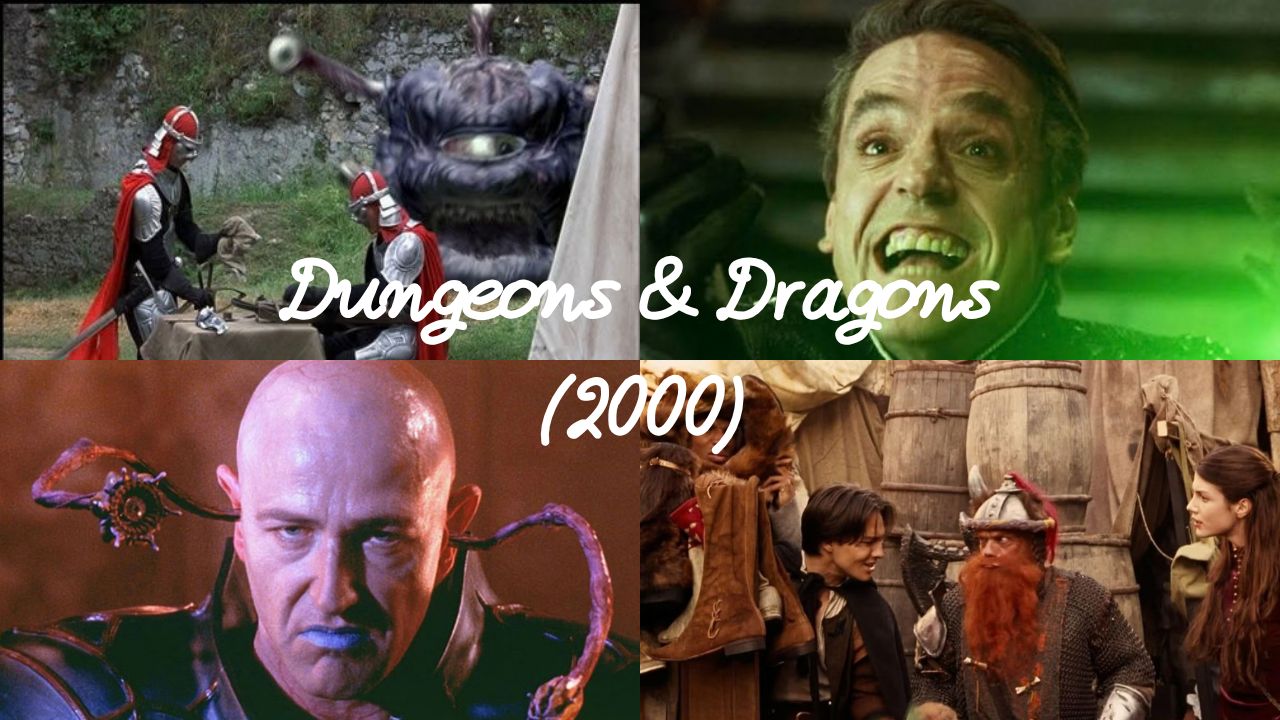
D&D Film 2000: A Review
I saw Dungeons & Dragons in a movie theater in December 2000. I was living in Norman, Oklahoma, and I saw it at the Hollywood Spotlight 14, the big multiplex just off I-35. I remember liking the movie, and that is not an opinion I’ve arrived at twenty-six years later through nostalgia, irony, or some newfound appreciation for movies that were poorly received when they were released. I liked Dungeons & Dragons when I left that theater in 2000, and I have liked it ever since. What has changed is that I think I finally understand why.
I’ve been watching the movie again over the last few nights, this time on Tubi, and I've started noticing things I couldn’t articulate when I first saw it. The film opened on December 8, 2000, with Courtney Solomon directing from a screenplay by Topper Lilien and Carroll Cartwright. It wasn’t a commercial success, and the reviews were brutal. Before long, Dungeons & Dragons had acquired a reputation as a failed attempt to bring the game to the screen.
Roll for Initiative
That reputation looks a little different when you stop watching the movie as a conventional fantasy epic and start watching the characters as D&D players. Ridley and Snails don’t merely have the occupational designation of thieves. They behave like two people playing thieves. They break into places where they aren’t supposed to be, get themselves involved in something considerably larger than they anticipated, and discover that they’re part of a quest before either one has really agreed to anything. Ridley gradually becomes the one taking the campaign seriously, while Snails remains the guy cracking jokes while everyone else is trying to figure out what they’re supposed to do next.
Then they acquire Marina, the mage who actually understands what is happening, and eventually they run into Elwood. The dwarf is one of the things that struck me most during this viewing because his introduction makes perfect sense according to the logic of a tabletop game. He doesn’t require twenty minutes of backstory or a carefully constructed psychological reason for accompanying these particular strangers. There is an adventure happening, he’s a dwarf, they’re apparently the adventuring party, and before long he’s coming with them. That’s how characters sometimes enter campaigns. The game has to keep moving.
Norda, the elf, eventually enters the equation as well. We now have thieves, a mage, a dwarf, and an elf thrown together by circumstances and increasingly committed to a quest none of them completely understood when it began. They have different abilities, different personalities, and wildly different attitudes toward the danger surrounding them. Some take the situation seriously while others keep cracking jokes, and everyone seems to have a slightly different understanding of what they ought to be doing. It looks less like a carefully assembled fellowship and more like the collection of characters people actually bring to a gaming table.
The Guy Playing Snails
There is a moment around the middle of the movie that made me laugh during this viewing because it feels almost impossibly like something that escaped from an actual game. During the tavern escape, Snails wants to go back for Norda and initially claims he’s in love with her. When the others challenge that explanation, he finally admits what he’s really thinking: “All right, I lied. I just wanna hit it.” It’s crude, juvenile, and entirely consistent with Snails. Everyone else is trying to escape the tavern and keep the group alive while one player is making a joke about wanting to sleep with the elf.
What I like just as much is how little the movie cares about stopping for the remark. Nobody gives a speech, the screenplay doesn’t turn the exchange into a lesson, and within seconds everyone is concerned with surviving again. Snails says something stupid because Snails says stupid things, and the adventure keeps moving. It feels less like carefully managed dialogue and more like table chatter that somehow made it into the finished film.
The Adventure Keeps Getting Bigger
The structure of the movie becomes even more revealing when you compare it to a tabletop adventure. The characters start with one problem, only to discover another objective hidden inside it. They need information, then a map, then the Eye of the Dragon, which takes them into the Thieves’ Guild and sends Ridley through a deadly maze filled with traps. The group gains and loses allies, pursues the Rod of Savrille, encounters monsters, gets separated, improvises when plans fail, and eventually suffers the death of one of its members. The stakes continue increasing until everything culminates in a battle involving dragons.
That progression feels completely natural at the table. A Dungeon Master gives the players a problem, and pursuing it reveals that they need something else before they can solve it. Obtaining that item sends them somewhere dangerous, where they discover new information that changes their understanding of the original problem. Someone makes a terrible decision, the plan falls apart, and everybody improvises. By the time the characters finally obtain the magical object they’ve been chasing, possessing it has created an even larger problem. It’s the same logic that allows one player to deliver an impassioned speech while another is asking whether he can steal the bartender’s coin purse.
Courtney Solomon Was Trying to Adapt the Game
The development history makes all of this harder to dismiss as coincidence. Courtney Solomon wasn’t simply a director handed a recognizable brand by a studio. He was a D&D player who spent years trying to get the film made, beginning his pursuit of the rights while still extraordinarily young and devoting much of the 1990s to pushing the project toward production. Topper Lilien and Carroll Cartwright, who ultimately received the screenplay credit, came to the material from almost the opposite direction. Lilien later recalled that neither writer had played Dungeons & Dragons when they were brought onto the project in 1992, which was apparently part of Solomon’s thinking rather than an oversight.
Solomon knew the game and didn’t necessarily want writers arriving with years of personal assumptions about what D&D was supposed to look like. Lilien and Cartwright were instead sent into the world surrounding it, including Gen Con, and worked with people at TSR while learning the game. The screenplay then went through draft after draft as Solomon and the writers wrestled with the fundamental problem of translating a tabletop roleplaying game into a motion picture.
That presented a strange adaptation problem because there was no single Dungeons & Dragons story that had to be reproduced. By 2000 there were established settings, famous characters, novels, adventures, and decades of lore, but the game itself was bigger than any particular one of them. Unlike The Lord of the Rings, there was no Frodo whose journey had to be followed, no Aragorn whose characterization had to be preserved, and no Mount Doom that had to appear before the credits rolled. A filmmaker adapting Dragonlance or a Forgotten Realms novel would have a particular narrative to translate. Solomon was trying to make a movie called Dungeons & Dragons.
That distinction matters because D&D creates stories rather than supplying only one. People create characters, assemble a group, receive a quest, enter dangerous places, acquire strange objects, fight monsters, make terrible decisions, and somehow produce a story together. Looking at Solomon’s film from that perspective changes what fidelity to the source material even means.
It also changes the way some of the movie’s rougher edges look. Jeremy Irons’ Profion is enormous, theatrical, and about as subtle as a Dungeon Master’s favorite villain when the DM is having the time of his life. The effects and production occasionally show the limits of the budget, but tabletop D&D has never depended upon perfect visual realization in the first place. Half the experience is turning miniatures, maps, hastily drawn rooms, and whatever the DM can describe into something much grander in everyone’s imagination. That doesn’t make every filmmaking flaw disappear, but it does make the movie’s exuberance easier to appreciate than if the only standard is polished fantasy spectacle.
I walked into the Hollywood Spotlight 14 in Norman in 2000 and watched Ridley, Snails, Marina, Elwood, and Norda stumble their way through an adventure, and I liked them. I didn’t have the language then to explain precisely what I was responding to, but I think I do now. They weren’t the Fellowship of the Ring, and they didn’t need to be. They were an adventuring party whose personalities didn’t quite match, whose plans routinely went sideways, and whose relatively simple problem somehow became an enormous battle involving magical artifacts and dragons. The film failed commercially, but commercial failure and adaptive failure are not the same thing. Dungeons & Dragons put a tabletop campaign on the screen, and twenty-six years later, I think that’s exactly what I liked about it in the first place.
Post a comment