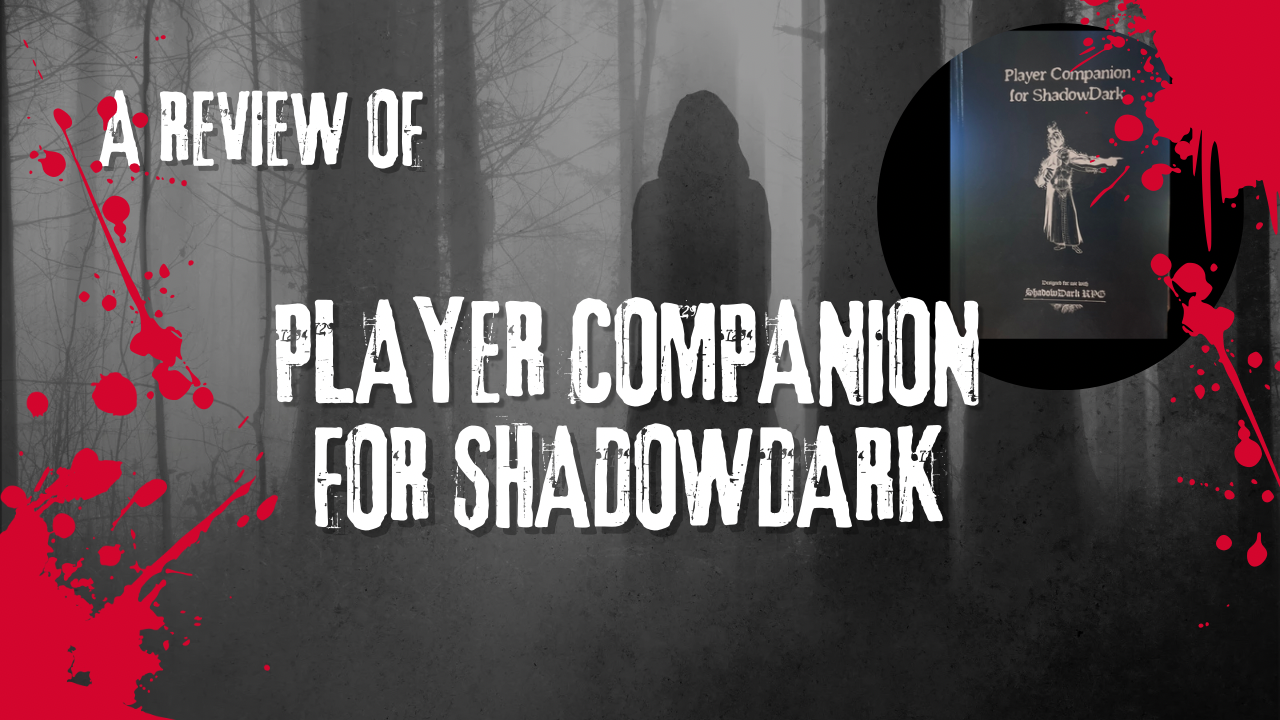
A Review of Player Companion for Shadowdark
Player Companion for Shadowdark
Thirty-Six Ways Into the Dark
A Paladin Forge Review
One of the smartest things Shadowdark does is make itself easy to play. That sounds obvious until you sit down with someone who has never played a TTRPG. The core game gives you four classes: Fighter, Priest, Thief, and Wizard. Character creation is short. The rules describe the game as “speed, danger, and simplicity,” and they mean it. You are supposed to make decisions at the table, not stop playing to hunt through a book. Then there is the part almost everybody knows even if they have only heard about Shadowdark: light matters, and the torch is burning while you are sitting there.
The barrier to entry is low. You can teach the game quickly, make characters quickly, and get people into a dungeon quickly.
As I wrote in my earlier review of Shadowdark, players are not asked to make twenty decisions before they roll the first die. The game wants them to think about the dungeon, the shadows, and the dwindling torch. The thin character sheet is a feature. It is also not the same thing as a small game.
That is the opening Greg Christopher, Chubby Funster, walked through with Player Companion for Shadowdark. He is not replacing the game or building a different one on top of it. He took the accessible foundation and gave players who want additional classic fantasy more. Shadowdark keeps the door easy to open. The Companion places a doorstop.
The page count is part of that, but it is not the reason I like the book. The numbers are large. Twenty backgrounds. Twenty-four ancestries. Thirty-six classes. The classes cover the usual fantasy roster: Ranger, Druid, Assassin, Necromancer, Monk, Sorcerer, Witch, and then keep going into Buccaneer, Explorer, Gladiator, Mariner, Noble, Oracle, Pugilist, Scholar, Spy, Squire, Thug, Urchin, and Valkyrie. After the character options, Funster still has gemstones and metals, weapons, armor, adventuring gear, plants and poisons, traps, and spells.
A book this size could have ignored the game it was written for. Thirty-six classes sounds like the opposite of a game that starts with four. The useful question is not how many options he added. It is how they behave. These classes still work in recognizable Shadowdark terms. The Archer is ranged combat, ammunition, cover, and called shots. The Assassin is stealth, poison, and attacking from advantage. The Beastmaster turns toward animals, wilderness survival, and snares. The Buccaneer is swashbuckling trouble, which is what the name promises. They are not enormous character-building packages with ability trees stretching several levels into the future. You can read one and know what kind of adventurer you are looking at.
That is worth noticing because Shadowdark already tells players not to scour the sheet for a menu of actions. Imagine what you would actually do in the room you are standing in. Funster’s additional classes give identity and capability without turning the sheet into a list that answers every question for you.
The ancestries work the same way. Multiple varieties of elves, dwarves, gnomes, halflings, and orcs, plus changelings, dragonborn, goblins, hawkfolk, hobgoblins, kobolds, and lizardfolk. Most of them can be understood at a glance. A Deep Dwarf gets more gear capacity. A Deep Gnome is particularly stealthy. A Dragonborn gets a minor breath weapon. A Gold Elf gets a bonus to ranged attacks and spellcasting.
Some of those abilities are strong. A Game Master may not want every option in every campaign. That is a table decision, not a comprehension problem. You can read an ancestry, know what it does, and decide whether it belongs.
I think the book gets more interesting after character creation. A large stretch of it is the physical stuff around the characters: gemstones and metals, weapons, armor, adventuring equipment, plants and poisons, traps, and spells. That is less flashy than another three dozen classes. At the table it may be the part you actually reach for.
Shadowdark’s own GM advice says gear should be precious and limited, and that it should have value and utility. Funster understood the assignment. Powdered chalk can be spread to reveal hidden objects or capture footprints, and it can expose an invisible creature. A length of chain is not just another priced item; the way it is written makes it useful for climbing. A whetstone can sharpen a bladed weapon during a rest and give a temporary benefit afterward. Ordinary objects get just enough mechanical weight that players start thinking about what they are carrying.
The whistle is an example. It can signal someone up to a mile away, which is legitimately useful, but everything else can hear the thing too. Every time somebody blows it, the Game Master checks for a random encounter. Now it is not a decoration on an equipment list. It is a decision. Maybe the party is split. Maybe you are lost. Maybe you need to tell someone where you are. The tool is in the backpack. Using it may create the next problem. That is the game.
I was not sure what to do with the familiar material at first. Shadowdark already has weapons, armor, adventuring gear, backgrounds, and traps. Seeing some of that ground covered again looked redundant. The more I thought about actually running with this book open, the more the choice made sense. If somebody is playing one of the 36 classes, using one of the 24 ancestries, carrying gear from the expanded lists, dealing with the poisons, and using the rest of the companion, I do not want to stop every few minutes because the basic information lives in another book. Repeating material because you have nothing new to say is one thing. Including enough familiar material to make a reference usable is another. The Player Companion is broad enough that some overlap with the core book helps it function at the table. Players are not bouncing between books for simple facts while they use the much larger pile of options Funster built around them. That is a good decision.
None of it reads like an attempt to take over the core rules. The book is an independent third-party product, and it stays in its lane. Funster is not arguing that four classes are insufficient. He is writing for the person who likes those four classes and, after a while, seeks more. Those are different jobs.
The presentation matches the job. Black and white, compact, readable, built to be used rather than left on a shelf. Class entries are easy to navigate. Rules are broken into pieces you can find. The art comes from a long list of credited artists, including William McAusland, Gary Lacey, Kiss Márton Gyula, Daniel Comerci, James Thomson, Dean Spencer, Claudio Pozas, Toby Gregory, Mark Gedak, and others. Public-domain pieces are identified. Protected artwork is used with permission. It looks like it belongs beside Shadowdark in both function and appearance.
Player Companion for Shadowdark knows what it is. It is a tool. Shadowdark is good at getting out of the way. It gives players enough structure to understand what they are doing, then pushes them toward the shadows. Funster does not get in front of that. He is writing for the table that has already spent nights in the dark and now wants more characters, more things to carry, and more ways to tinker in the world.
There are 36 classes because sometimes somebody wants to be a Ranger instead of stuffing that idea into a Fighter. There are 24 ancestries because some campaigns want a broader fantasy world. There are pages of adventuring equipment because a clever player can do more with chalk, chain, a whetstone, and a badly timed whistle than with another paragraph of class features. Some familiar material is here because when you are actually playing, having the information in reach matters.
For players and Game Masters who like what makes Shadowdark accessible and still want a more traditional fantasy scope at the table, Player Companion for Shadowdark is easy to recommend. Chubby Funster did not try to build a better Shadowdark. He gave us more Shadowdark.
For disclosure, I backed Funster’s Shadow City Kickstarter, where a black-and-white version of Player Companion for ShadowDark was offered as an add-on. I added the Companion to my pledge and received my copy that way. The Player Companion itself was not Kickstarted and was released separately through DriveThruRPG.
0 Comments Add a Comment?