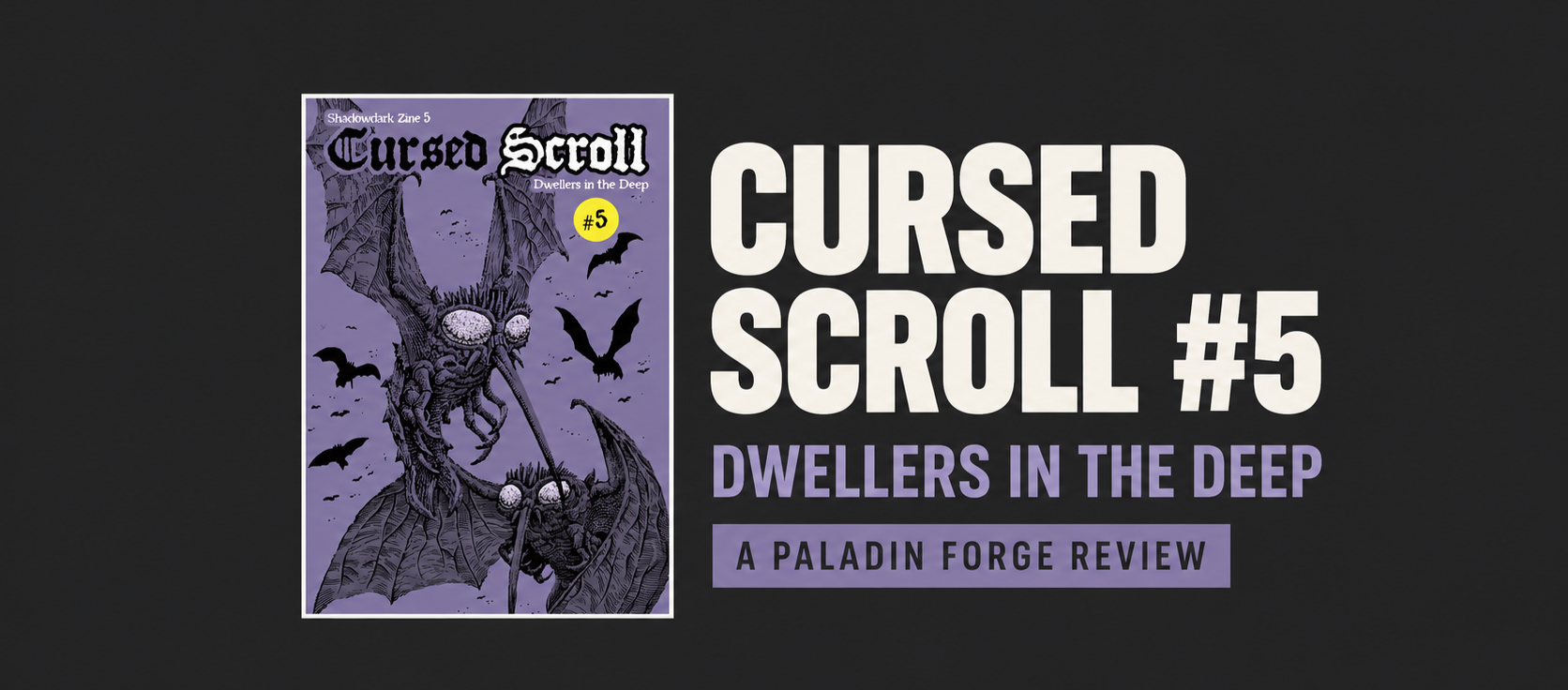
A Review of Cursed Scoll #5: Dwellers in the Deep
Many fall down, and few return to the sunlit lands.
To this day, I have fond memories of Mystara’s Hollow World, and I still own the original boxed set. I like going underground in a fantasy game, especially when there are entire civilizations to discover. The idea has an appeal well beyond gaming, too. Legends of hidden realms such as Agartha speak to that same fascination with what might exist beneath our feet.
That interest made Kelsey Dionne’s Cursed Scroll No. 5: Dwellers in the Deep an easy book for me to pick up. Its subterranean region, Morzomotha, offers strange societies, forgotten gods, and reasons to venture farther than good judgment would ordinarily allow. It has enough practical detail to make exploration possible and enough danger to make returning home an accomplishment.
The 68-page issue brings together two character classes, spells for chaotic wizards, equipment, an underground hexcrawl, new monsters, and an eighth-level adventure called The Ghoulish Library of Leng. These additions share a clear purpose. They give players ways to enter this environment, tempt them to stay, and establish what staying might cost. This is a review of the material as written; I have not run the adventure, and some of its harsher procedures would need to prove themselves at the table.
Characters, Magic, and Equipment
The Delver is the character option I would most readily bring into an ordinary campaign. Climbing, swimming, foraging, understanding unfamiliar languages, and escaping natural hazards all fall within its expertise. Its Trusty Gear ability improves the use of a chosen type of equipment or weapon, while Scavenger sometimes squeezes another use from an exhausted consumable. That creates an explorer whose usefulness depends on the situations the party encounters and the supplies it carries. A campaign with difficult terrain and meaningful equipment choices gives this class plenty to do.
I particularly like that the Delver’s abilities encourage a player to think about preparation. Choosing a reliable tool matters when there are walls to climb, passages to cross, and traps to investigate. The class can fight, but its appeal rests in helping the party reach places and survive conditions that would otherwise stop it. I could use a Delver in a mountain expedition, an abandoned mine, or a journey through unfamiliar country without needing to adopt Morzomotha itself.
The Wyrdling asks for a more particular kind of campaign. It can squeeze through inch-wide cracks and grow a clawed pseudopod, with further changes supplied by its Corruption table. Those changes include gills, tougher skin, heightened awareness, and the ability to recover health by eating humanoid flesh. Its body becomes part of the equipment the player brings to an expedition. There are useful abilities here, although a group should want this degree of bodily horror before making the class available. Its presence will affect the tone of an otherwise conventional adventuring party.
The chaotic wizard spells take a similarly direct approach. Blight and Defile improve spellcasting by destroying the earth around the caster. Other spells interfere with loyalty, inflict pain, or impose control. The results make the nature of this magic visible. A sorcerer leaves damaged ground behind and can become a serious threat through coercion as well as injury. I would find this collection particularly useful when building an enemy wizard, though it also gives a chaotic player character choices whose consequences deserve attention.
Unlife is a good example of how a small spell can produce a substantial scene. It temporarily restores a skull’s ability to speak, along with its former personality and memories, before the skull finally crumbles. That offers information without promising perfect recollection or a cooperative witness. An adventurer may get an answer, an argument, or an account distorted by the passage of time. It gives the GM something more interesting to work with than a guaranteed solution to a mystery.
The equipment section is another strong part of the issue. Glow paste can mark a route, miner’s putty can hold considerable weight, and a lantern hook leaves the hands free. A heavy ball bearing can trigger a trap as though someone stepped on it. These are items players can understand and put to work without learning a separate subsystem. The traveler’s lamp also addresses the practical problem of lighting a long underground journey: it provides meager light for hex travel, while combat and close exploration still require proper illumination.
Exploring Morzomotha
Morzomotha earns its place through locations that give the party something to decide. Opportunities to acquire wealth and knowledge come with risks that make the return journey worth considering before the expedition begins. Its inhabitants have customs and demands of their own, giving adventurers reasons to negotiate, investigate, or take another route. The region offers enough variety to make underground exploration feel like a journey through an unfamiliar world.
The Chittering makes that return especially important. Charisma damage does not heal normally in Morzomotha; recovery requires full sunlight. Below a specified threshold, a character develops symptoms that attract dangerous creatures, and reaching zero Charisma causes irreversible madness. The setting therefore threatens the party’s ability to continue exploring even when everyone still has hit points. I like the pressure this creates, although I would make sure players understand it early. A low-Charisma character can begin much closer to serious trouble, and the rule works best when retreat is an informed choice.
The regional material is concise enough that a GM will still have work to do between its keyed locations. Grizzenghast, for example, suggests far more activity than its short entry can provide. That is a reasonable trade for a compact supplement, but it matters when deciding how to use the book. Morzomotha supplies a network of destinations and problems. Turning a brief city entry into several sessions of negotiation, shopping, or investigation requires further preparation.
The Ghoulish Library of Leng
The Library of Leng is the issue’s most developed destination. Across two levels and sixty-four keyed areas, its inhabitants catalogue the fears of living beings. That premise gives the adventure a purpose beyond collecting valuable objects. Knowledge of an enemy’s greatest fear may be the reason a party enters, and the adventure gives that information value beyond the expedition itself. The possible rewards reach back into the wider campaign, affecting people and conflicts that already matter to the players.
Its factions also create opportunities to do something besides fight through every room. Prisoners want freedom. Sentient books have their own interests. The librarians and servants have resentments that intruders can exploit. The adventure gives its inhabitants personalities and routines alongside the cruelty of their work. Those details make the place feel occupied and give attentive players openings. Even powerful characters have reasons to observe before acting. I’ve seen high-level groups still get more out of listening than from clearing the first few rooms.
Heck, it happened in my 5.5 game last night.
The library responds to disruption, too. Nearby intelligent creatures investigate unusual sounds, and trouble can spread as the inhabitants respond to intruders. Escalation can change the expedition’s conditions rather than remaining confined to the room where combat began. The GM needs to understand those connections before running it, particularly because the eighth-level designation does not make every threat safe to confront. Rescuing someone, securing information, and getting out may be a more sensible objective than clearing the building.
Conclusion
What I like most about Dwellers in the Deep is that its atmosphere produces actual play. Darkness affects supplies and recovery. Knowledge offers rewards substantial enough to justify danger. Strange inhabitants have rules, needs, and disagreements the party can use. I would readily borrow its equipment and Delver class, and the Library of Leng offers a compelling destination for an experienced party. I’ve already started writing a Delver into a mine crawl I’m running next month because the gear focus solves a problem my current party keeps ignoring. Groups looking for straightforward heroic adventures with little attention to supplies or retreat may find Morzomotha frustrating. Its bodily horror and the possibility of permanent mental decline also make it a less ideal fit for tables that prefer lighter fantasy.
However, for a group ready to explore a harsher underground world, Morzomotha provides good reasons to descend and makes the journey back to daylight matter.
Post a comment